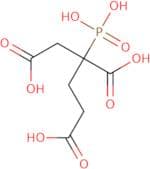
CAS 37971-36-1
:2-Phosphonobutan-1,2,4-tricarbonsäure
Beschreibung:
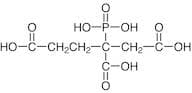
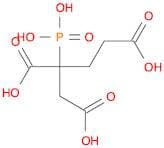
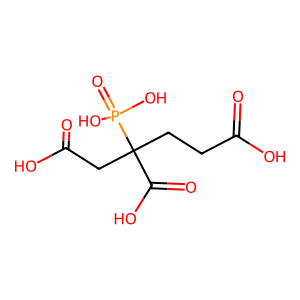
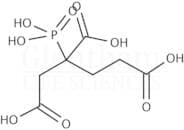
2-Phosphonobutan-1,2,4-tricarbonsäure, allgemein als PBTC bezeichnet, ist eine organophosphorverbindung, die durch ihre drei Carbonsäuregruppen und eine Phosphonsäuregruppe gekennzeichnet ist. Diese Struktur verleiht einzigartige Eigenschaften, die es zu einem vielseitigen Chelatbildner und Skaleninhibitor in verschiedenen industriellen Anwendungen machen, insbesondere in der Wasseraufbereitung und der Ölrückgewinnung. PBTC ist bekannt für seine Fähigkeit, stabile Komplexe mit Metallionen zu bilden, was hilft, die Bildung von Ablagerungen in Systemen zu verhindern, in denen Calcium- und Magnesiumionen vorherrschen. Darüber hinaus zeigt es eine gute thermische Stabilität und Löslichkeit in Wasser, was seine Wirksamkeit in wässrigen Umgebungen erhöht. Die Verbindung wird typischerweise in Formulierungen verwendet, um die Effizienz von Reinigungsmitteln zu verbessern und die Leistung von Korrosionsinhibitoren zu steigern. Sein Umweltprofil ist im Allgemeinen günstig, da es biologisch abbaubar und weniger toxisch ist als andere Phosphonate. Insgesamt wird 2-Phosphonobutan-1,2,4-tricarbonsäure für seine multifunktionalen Eigenschaften in chemischen und industriellen Anwendungen geschätzt.
Formel:C7H11O9P
InChl:InChI=1S/C7H11O9P/c8-4(9)1-2-7(6(12)13,3-5(10)11)17(14,15)16/h1-3H2,(H,8,9)(H,10,11)(H,12,13)(H2,14,15,16)
InChI Key:InChIKey=SZHQPBJEOCHCKM-UHFFFAOYSA-N
SMILES:C(CCC(O)=O)(CC(O)=O)(P(=O)(O)O)C(O)=O
Synonyme:- 1,2,4-Butanetricarboxylic acid, 2-phosphono-
- 1,2,4-Tricarboxy-sec-butylphosphonic acid
- 2-Phosphonbutane-1,2,4-tricarboxylic acid
- 2-Phosphono butane-1,2,4-tricarboxylic acid
- 2-Phosphono-1,2,4-butanetricarboxylic acid
- 2-Phosphonobutane-1,1,1-Tricarboxylic Acid
- 2-Phosphonobutyl-1,2,4-tricarboxylic acid
- 3-Carboxy-3-phosphonohexanedioic acid
- Bayhibit AM
- Bayhibit AM 50
- Belclene 650
- Chelest PH 430
- Cublen P 50
- Dequest 7000
- Jh 906
- Mayoquest 2100
- Pbdca
- Pbs-Am
- Pbtc
- Pbtca
- Phosphonobutanetricarboxylic acid
- Weitere Synonyme anzeigen
Sortieren nach
Reinheit (%)
0
100
|
0
|
50
|
90
|
95
|
100
5 Produkte.
2-Phosphonobutane-1,2,4-tricarboxylic Acid (ca. 50% in Water)
CAS:Formel:C7H11O9PFarbe und Form:Colorless to Light yellow clear liquidMolekulargewicht:270.132-Phosphonobutane-1,2,4-Tricarboxylic Acid
CAS:Formel:C7H11O9PReinheit:%Farbe und Form:LiquidMolekulargewicht:270.13062-Phosphonobutane-1,2,4-Tricarboxylic Acid
CAS:2-Phosphonobutane-1,2,4-Tricarboxylic AcidMolekulargewicht:270.13g/mol2-Phosphonobutane-1,2,4-tricarboxylic acid solution
CAS:Formel:C7H11O9PFarbe und Form:Colourless to pale yellow liquidMolekulargewicht:270.132-Phosphonobutane-1,2,4-tricarboxylic acid, 50% aqueous solution
CAS:Polymerase chain reaction (PCR) is a technique that can be used to amplify a specific segment of DNA. This technique is based on the use of primers, which are short single strands of DNA, to initiate DNA synthesis. The PCR process consists of two steps: 1) an initial denaturation step in which the temperature is raised to 90-95°C for 10 minutes and 2) a series of 30-40 cycles consisting of a sequence of 94°C for 30 seconds, 55°C for 20 seconds, and 72°C for 10 seconds. The optimum concentration for the polymerase chain reaction depends on the type of polymerase enzyme used and the type of nucleotide or base being added. Nitrogen atoms are found in all living organisms and have been shown to be necessary for bacterial growth. When nitrogen atoms are removed from water vapor, it has been shown that bacteria will not grow as well as when there are nitrogen atoms present. Inhibitor molecules such as benzalkFormel:C7H11O9PReinheit:Min. 95%Molekulargewicht:270.13 g/mol