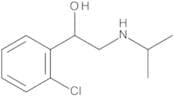
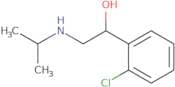
CAS 3811-25-4
:Clorprenalin
Beschreibung:
Clorprenalin, mit der CAS-Nummer 3811-25-4, ist eine synthetische Verbindung, die als Beta-Adrenozeptor-Agonist klassifiziert ist. Sie wirkt hauptsächlich auf Beta-2-Adrenozeptoren, was zu Bronchodilatation und Entspannung der glatten Muskulatur führt, wodurch sie nützlich bei der Behandlung von Atemwegserkrankungen wie Asthma und chronisch obstruktiver Lungenerkrankung (COPD) ist. Clorprenalin ist bekannt für seine Fähigkeit, das Herz zu stimulieren und die Herzfrequenz zu erhöhen, obwohl seine primäre therapeutische Anwendung im Atemwegssystem liegt. Die Verbindung wird typischerweise durch Inhalation oder oral verabreicht, abhängig von der Formulierung. Neben seinen bronchodilatierenden Effekten kann Clorprenalin entzündungshemmende Eigenschaften aufweisen, die zu seiner Wirksamkeit bei der Behandlung von Atemwegserkrankungen beitragen. Wie bei vielen Beta-Agonisten können mögliche Nebenwirkungen Tachykardie, Zittern und Nervosität umfassen, insbesondere bei höheren Dosen. Seine Verwendung ist in verschiedenen Ländern reguliert, insbesondere in der Tiermedizin, wo es manchmal eingesetzt wird, um die Leistung von Nutztieren zu verbessern. Insgesamt ist Clorprenalin ein bedeutendes Mittel im pharmakologischen Management von Atemwegserkrankungen.
Formel:C11H16ClNO
InChl:InChI=1S/C11H16ClNO/c1-8(2)13-7-11(14)9-5-3-4-6-10(9)12/h3-6,8,11,13-14H,7H2,1-2H3
InChI Key:InChIKey=SSMSBSWKLKKXGG-UHFFFAOYSA-N
SMILES:C(CNC(C)C)(O)C1=C(Cl)C=CC=C1
Synonyme:- (±)-Chloroprenaline
- 1-(2-Chlorophenyl)-2-(Propan-2-Ylamino)Ethanol
- 1-(2-Chlorophenyl)-2-Isopropylaminoethanol
- 1-(2-Chlorophenyl)-2-[(propan-2-yl)amino]ethan-1-ol
- 1-o-Chlorophenyl-2-isopropylaminoethanol
- 2-Chloro-α-[(isopropylamino)methyl]benzenemethanol
- 2-Chloro-α-[[(1-methylethyl)amino]methyl]benzenemethanol
- Benzenemethanol, 2-chloro-α-[[(1-methylethyl)amino]methyl]-
- Benzyl alcohol, o-chloro-α-[(isopropylamino)methyl]-
- E 241
- Isoprofenamine
- Isoprophenamine
- o-Chloro-α-(isopropylaminomethyl)benzyl alcohol
- Weitere Synonyme anzeigen
Sortieren nach
Reinheit (%)
0
100
|
0
|
50
|
90
|
95
|
100
6 Produkte.
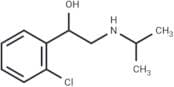
1-(2-chlorophenyl)-2-[(propan-2-yl)amino]ethan-1-ol
CAS:Formel:C11H16ClNOReinheit:98%Molekulargewicht:213.7038Clorprenaline 100 µg/mL in Acetonitrile
CAS:Formel:C11H16ClNOFarbe und Form:Single SolutionMolekulargewicht:213.70Clorprenaline
CAS:Clorprenaline is a β-adrenergic receptor agonist that activates adenylate cyclase, relaxation of bronchial smooth muscle cells. anti-inflammatory.Formel:C11H16ClNOReinheit:98.9%Farbe und Form:SolidMolekulargewicht:213.7(±)-Clorprenaline-d7 (iso-propyl-d7)
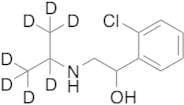
CAS:Kontrolliertes ProduktApplications (±)-Clorprenaline-d7 (iso-propyl-d7) is a useful isotopically labeled compound of Clorprenaline (C587150)
Formel:C112H7H9ClNOFarbe und Form:NeatMolekulargewicht:220.75Clorprenaline Hydrochloride-D7
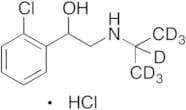
CAS:Kontrolliertes ProduktStability Hygroscopic
Applications Clorprenaline Hydrochloride-D7 is an isotopically labeled form of Clorprenaline Hydrochloride (C427955). Clorprenaline Hydrochloride is a beta-adrenergic blocking agent.
References Zhou, S., et al.: Elctrophoresis, 29, 321 (2008);Formel:C11H9D7ClNO•HClFarbe und Form:NeatMolekulargewicht:257.21Clorprenaline
CAS:Clorprenaline is a sympathomimetic drug that binds to and activates the beta-adrenergic receptors, which are found in the heart, lungs, kidneys and other tissues. Clorprenaline is used as a bronchodilator in chronic pulmonary diseases such as asthma. It has also been used as a cardiac stimulant and an antihypertensive agent. Clorprenaline has been shown to be a good absorption enhancer for drugs with poor bioavailability. The hydroxyl group on clorprenaline reacts with fatty acids to form esters. These reactions can be monitored by gas chromatography with flame ionization detection (GC-FID) or high-performance liquid chromatography (HPLC). A monoclonal antibody was used for the detection sensitivity of clorprenaline in plasma samples from patients with chronic lung disease who were administered clorprenaline via inhalation therapy. Sodium citrate is often added to the sample buffer because it increases theFormel:C11H16ClNOReinheit:Min. 95%Molekulargewicht:213.7 g/mol
![1-(2-chlorophenyl)-2-[(propan-2-yl)amino]ethan-1-ol](/_next/image/?url=https%3A%2Fstatic.cymitquimica.com%2Fproducts%2FIN%2Fthumb%2FDA00ILQA.jpg&w=3840&q=75)