CAS 38222-83-2
:2,6-Di-tert-butyl-4-methylpyridin
Beschreibung:
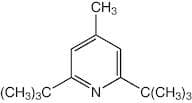
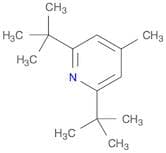
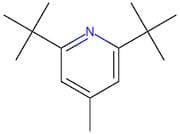
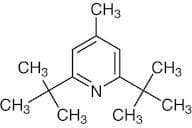
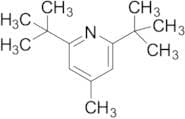
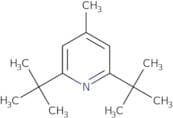
2,6-Di-tert-butyl-4-methylpyridin ist eine organische Verbindung, die durch ihren Pyridinring gekennzeichnet ist, der an den Positionen 2 und 6 mit zwei tert-Butylgruppen und an der Position 4 mit einer Methylgruppe substituiert ist. Diese Struktur trägt zu ihrer signifikanten sterischen Hinderung bei, was sie zu einem voluminösen Molekül macht. Es ist eine farblose bis blassgelbe Flüssigkeit oder ein Feststoff, abhängig von der Temperatur, und ist bekannt für seine Stabilität und geringe Flüchtigkeit. Die Verbindung zeigt basische Eigenschaften aufgrund des Stickstoffatoms im Pyridinring, das Protonen akzeptieren kann. Sie wird häufig als Additiv in verschiedenen chemischen Prozessen verwendet, insbesondere zur Stabilisierung von Polymeren und als Ligand in der Koordinationschemie. Darüber hinaus hat sie Anwendungen in der Synthese von Arzneimitteln und Agrochemikalien. Ihre relativ geringe Löslichkeit in Wasser und höhere Löslichkeit in organischen Lösungsmitteln machen sie für verschiedene industrielle Anwendungen geeignet. Sicherheitsdaten zeigen, dass sie mit Vorsicht behandelt werden sollte, da sie bei Kontakt mit Haut oder Augen Reizungen verursachen kann.
Formel:C14H23N
InChl:InChI=1S/C14H23N/c1-10-8-11(13(2,3)4)15-12(9-10)14(5,6)7/h8-9H,1-7H3
InChI Key:InChIKey=HVHZEKKZMFRULH-UHFFFAOYSA-N
SMILES:C(C)(C)(C)C=1N=C(C(C)(C)C)C=C(C)C1
Synonyme:- 4-Methyl-2,6-di-tert-butylpyridine
- 2,6-Di-tert-butyl-4-methylpyridine
- Pyridine, 2,6-bis(1,1-dimethylethyl)-4-methyl-
- 4-Picoline, 2,6-di-tert-butyl-
- 2,6-Bis(1,1-dimethylethyl)-4-methylpyridine
Sortieren nach
Reinheit (%)
0
100
|
0
|
50
|
90
|
95
|
100
7 Produkte gefunden.
2,6-Di-tert-butyl-4-methylpyridine, 97%
CAS:2,6-Di-tert-butyl-4-methylpyridine is used for the generation of enol triflates from ketones using trifluoromethanesulfonic anhydride. It is also used in the synthesis of 1,2-dihydro-2-silanaphthalene derivatives, as base in PtCl4-catalyzed cyclization reactions of homopropargyl azide derivatives anFormel:C14H23NReinheit:97%Farbe und Form:White to pale yellow or brown, Crystals or powder or crystalline powder or crystalline chunks or fused/lumpy solidMolekulargewicht:205.352,6-DI-TERT-BUTYL-4-METHYLPYRIDINE
CAS:Formel:C14H23NReinheit:98%Farbe und Form:SolidMolekulargewicht:205.33912,6-Bis(tert-butyl)-4-methylpyridine
CAS:2,6-Bis(tert-butyl)-4-methylpyridineReinheit:98%Farbe und Form:SolidMolekulargewicht:205.34g/mol2,6-Di-tert-butyl-4-methylpyridine
CAS:Formel:C14H23NReinheit:>98.0%(GC)(T)Farbe und Form:White to Orange to Green powder to lumpMolekulargewicht:205.352,6-Di-tert-Butyl-4-methylpyridine
CAS:Kontrolliertes ProduktFormel:C14H23NFarbe und Form:NeatMolekulargewicht:205.342,6-Di-tert-butyl-4-methylpyridine
CAS:2,6-Di-tert-butyl-4-methylpyridine (2,6-DBMP) is a thianthrene derivative that has been used in asymmetric synthesis and transfer reactions. 2,6-DBMP is synthesized by reacting the appropriate carbonyl chloride with the corresponding 2,6-di-tert butylpyridine. It can also be prepared by the palladium catalyzed coupling of a benzyl halide and an allyl bromide. The compound's stereoselectivity depends on the reactants' configuration at C2. This property makes it useful for the preparation of chiral molecule such as oligosaccharides and methyl glycosides. 2,6-DBMP has shown to have immunomodulatory activity against mutant strains of human erythrocytes in vitro.
Formel:C14H23NReinheit:Min. 97%Farbe und Form:Solidified MassMolekulargewicht:205.34 g/mol2,6-Di-tert-butyl-4-methylpyridine
CAS:Formel:C14H23NReinheit:97%Farbe und Form:SolidMolekulargewicht:205.345