CAS 38428-14-7
:2-Methylpropyl 2-(2-methylpropoxy)-1(2H)-chinolincarboxylat
Beschreibung:
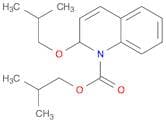
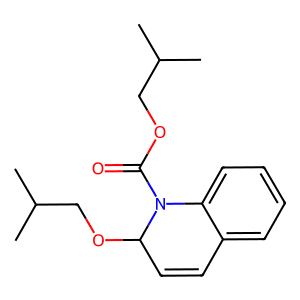
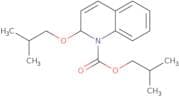
2-Methylpropyl 2-(2-methylpropoxy)-1(2H)-chinolincarboxylat, mit der CAS-Nummer 38428-14-7, ist eine organische Verbindung, die durch ihre komplexe Struktur gekennzeichnet ist, die ein Quinolinring-System umfasst. Diese Verbindung weist eine Carboxylat-Funktionalgruppe auf, was darauf hinweist, dass es sich um ein Ester handelt, und sie ist substituiert mit einer 2-Methylpropylgruppe und einer 2-Methylpropoxygruppe. Das Vorhandensein dieser Alkylgruppen trägt zu ihrer hydrophoben Natur bei, was potenziell ihre Löslichkeit in organischen Lösungsmitteln anstelle von Wasser beeinflusst. Die Quinolin-Einheit ist bekannt für ihre biologische Aktivität und zeigt häufig Eigenschaften wie antimikrobielle oder antitumorale Effekte. Die molekulare Struktur der Verbindung deutet darauf hin, dass sie an verschiedenen chemischen Reaktionen teilnehmen kann, die typisch für Ester sind, einschließlich Hydrolyse und Transesterifizierung. Ihre spezifischen Anwendungen und Reaktivität würden vom Kontext ihrer Verwendung abhängen, insbesondere in der Pharmazie oder in Agrochemikalien, wo Quinolin-Derivate häufig auf ihr therapeutisches Potenzial untersucht werden. Sicherheits- und Handhabungshinweise sollten beachtet werden, wie bei allen chemischen Substanzen, aufgrund möglicher Toxizität oder Reaktivität.
Formel:C18H25NO3
InChl:InChI=1S/C18H25NO3/c1-13(2)11-21-17-10-9-15-7-5-6-8-16(15)19(17)18(20)22-12-14(3)4/h5-10,13-14,17H,11-12H2,1-4H3
InChI Key:InChIKey=LPBHYOYZZIFCQT-UHFFFAOYSA-N
SMILES:C(OCC(C)C)(=O)N1C=2C(C=CC1OCC(C)C)=CC=CC2
Synonyme:- 1(2H)-Quinolinecarboxylic acid, 2-(2-methylpropoxy)-, 2-methylpropyl ester
- 1-Isobutoxycarbonyl-2-isobutoxy-1,2-dihydroquinoline
- 2-Isobutoxy-1-isobutoxycarbonyl-1,2-dihydroquinoline
- 2-Isopropoxy-1-isopropoxycarbonyl-1,2-dihydroquinoline
- 2-Methylpropyl 2-(2-methylpropoxy)-1(2H)-quinolinecarboxylate
- 2-Methylpropyl 2-(2-methylpropoxy)-1,2-dihydroquinoline-1-carboxylate
- 2-methylpropyl (2R)-2-(2-methylpropoxy)quinoline-1(2H)-carboxylate
- 2-methylpropyl (2S)-2-(2-methylpropoxy)quinoline-1(2H)-carboxylate
- 2-methylpropyl 2-(2-methylpropoxy)quinoline-1(2H)-carboxylate
- Iidq (2-Isobutoxy-1-Isobutoxycarbonyl-1,2-Dihydro
- Iidq 1-Isobutoxycarbonyl-2-Isobutoxy-1,2-Dihydroquinoline
- Isobutyl 1,2-dihydro-2-isobutoxy-1-quinoline-carboxylate
- NSC 332545
- Weitere Synonyme anzeigen
Sortieren nach
Reinheit (%)
0
100
|
0
|
50
|
90
|
95
|
100
4 Produkte.
Isobutyl 1,2-dihydro-2-isobutoxy-1-quinoline-carboxylate
CAS:Formel:C18H25NO3Reinheit:95%Farbe und Form:LiquidMolekulargewicht:303.3960Isobutyl 2-Isobutoxyquinoline-1(2H)-Carboxylate
CAS:Isobutyl 2-Isobutoxyquinoline-1(2H)-CarboxylateReinheit:95%Molekulargewicht:303.40g/mol1-Isobutoxycarbonyl-2-isobutoxy-1,2-dihydroquinoline
CAS:Formel:C18H25NO3Reinheit:95%Farbe und Form:Liquid, ClearMolekulargewicht:303.4022-Isobutoxy-1-isobutoxycarbonyl-1,2-dihydroquinoline
CAS:2-Isobutoxy-1-isobutoxycarbonyl-1,2-dihydroquinoline, also known as IIDQ, is an amide coupling reagent utilised in liquid-phase synthesis. With IIDQ there is no need for the pre-activation step and the efficiency of the coupling is not influenced by the order of the addition of the reagents (amine, carboxylic acid, IIDQ). Furthermore, no guanidinium species are formed with IIDQ, and IIDQ is stable in presence of base. IIDQ is mainly applied in its polymer-supported form, polystyrene-supported IIDQ (PS-IIDQ), which is stable, reactive and efficient. PS-IIDQ requires a simpler purification compared to the free IIDQ and can be easily regenerated. Some applications of PS-IIDQ are in the synthesis of protein conjugates for antibody development and xanthine derivatives to be used as adenosine receptor antagonists.Formel:C18H25NO3Reinheit:Min. 95%Farbe und Form:Colourless to light yellow viscous clear liquid.Molekulargewicht:303.4 g/mol