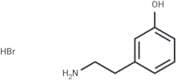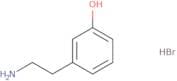
CAS 38449-59-1
:Phenol, 3-(2-aminoethyl)-, hydrobromid
Beschreibung:
Phenol, 3-(2-aminoethyl)-, hydrobromid, auch bekannt als 3-(2-Aminoethyl)phenolhydrobromid, ist eine chemische Verbindung, die durch ihre phenolische Struktur mit einer Aminoethyl-Seitenkette gekennzeichnet ist. Diese Verbindung erscheint typischerweise als weißes bis cremefarbenes kristallines Feststoff. Sie ist in Wasser und polaren organischen Lösungsmitteln löslich, was auf ihre hydrophile Natur hinweist, die auf das Vorhandensein sowohl der Hydroxylgruppe (-OH) des Phenols als auch der Aminogruppe (-NH2) der Aminoethylgruppe zurückzuführen ist. Die Hydrobromid-Salzform deutet darauf hin, dass es sich um eine protonierte Spezies handelt, die ihre Löslichkeit und Stabilität in wässrigen Lösungen erhöht. Diese Verbindung kann biologische Aktivität zeigen, was sie für die pharmazeutische und biochemische Forschung von Interesse macht. Ihre Eigenschaften, wie Schmelzpunkt, Siedepunkt und Reaktivität, können je nach den spezifischen Bedingungen und der Reinheit der Probe variieren. Wie viele phenolische Verbindungen kann sie auch an verschiedenen chemischen Reaktionen teilnehmen, einschließlich elektrophiler Substitutionen und Wasserstoffbrückenbindungen. Sicherheitsvorkehrungen sollten beim Umgang mit dieser Verbindung beachtet werden, da potenzielle Toxizität im Zusammenhang mit phenolischen Derivaten besteht.
Formel:C8H11NO・BrH
Sortieren nach
Reinheit (%)
0
100
|
0
|
50
|
90
|
95
|
100
2 Produkte.
m-Tyramine hydrobromide
CAS:m-Tyramine hydrobromide (3-(2-aminoethyl)phenol hydrobromide) is a dopamine derivative that acts by releasing newly synthesized catecholamines or 5-HT.Formel:C8H12BrNOReinheit:98.49%Farbe und Form:SolidMolekulargewicht:218.093-Hydroxyphenethylamine hydrobromide
CAS:3-Hydroxyphenethylamine hydrobromide is a synthetic compound that binds to the adenosine A1 receptor. 3-Hydroxyphenethylamine hydrobromide is used to study the interaction of adenosine A1 receptors with other compounds and its role in neuropathic pain. This drug has been shown to inhibit the contractions of guinea-pig trachea, which may be due to its ability to act as a fluorescent probe. Compounds that are able to bind to this receptor will have affinity constants (Ki) in the micromolar range. The interactions between 3-hydroxyphenethylamine hydrobromide and other compounds can also be studied using fluorescence probes, which allow for advances in research involving amines and their conjugates.Formel:C8H11NO•HBrReinheit:Min. 95%Farbe und Form:White to off-white solid.Molekulargewicht:218.09 g/mol