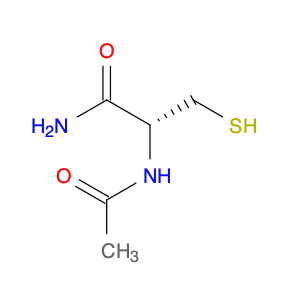
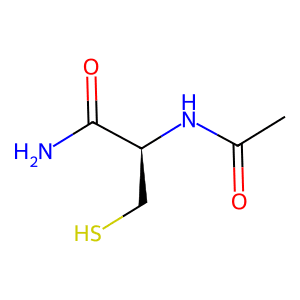
CAS 38520-57-9
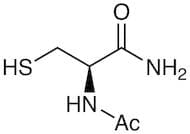
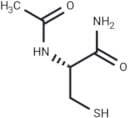
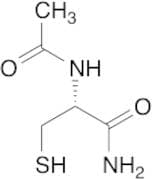
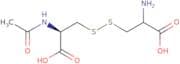
:N-Acetylcysteinamid
Beschreibung:
N-Acetylcysteinamid (NAC-Amid) ist ein Derivat der Aminosäure Cystein, das durch das Vorhandensein einer Acetylgruppe gekennzeichnet ist, die an das Stickstoffatom der Cystein-Seitenkette gebunden ist. Diese Verbindung ist bekannt für ihre antioxidativen Eigenschaften, die ihrer Fähigkeit zugeschrieben werden, die intrazellulären Spiegel von Glutathion, einem kritischen Antioxidans im Körper, wiederherzustellen. NAC-Amid wird häufig auf seine potenziellen therapeutischen Anwendungen untersucht, einschließlich seiner Rolle beim Schutz gegen oxidativen Stress und Entzündungen. Es ist in Wasser löslich und zeigt Stabilität unter verschiedenen pH-Bedingungen, was es für verschiedene Formulierungen geeignet macht. Darüber hinaus wird NAC-Amid als weniger geruchsintensiv im Vergleich zu seiner Ausgangsverbindung, N-Acetylcystein, angesehen, was seine Akzeptanz in bestimmten Anwendungen erhöhen kann. Forschungen zu seinen pharmakologischen Wirkungen deuten auf potenzielle Vorteile für die Atemwegsgesundheit, den Leber- und Neuroprotection hin, obwohl weitere Studien erforderlich sind, um seine Mechanismen und Wirksamkeit in klinischen Umgebungen vollständig zu klären.
Formel:C5H10N2O2S
InChl:InChI=1S/C5H10N2O2S/c1-3(8)7-4(2-10)5(6)9/h4,10H,2H2,1H3,(H2,6,9)(H,7,8)/t4-/m0/s1
InChI Key:InChIKey=UJCHIZDEQZMODR-BYPYZUCNSA-N
SMILES:[C@@H](NC(C)=O)(C(N)=O)CS
Synonyme:- (2R)-2-(Acetylamino)-3-mercaptopropanamide
- (2R)-2-Acetamido-3-sulfanylpropanamide
- (R)-2-Acetamido-3-mercaptopropanamide
- N-Acetyl-<span class="text-smallcaps">L</span>-cysteinamide
- N-Acetyl-L-cysteinamide
- N-Acetylcysteine amide
- Propanamide,2-(acetylamino)-3-mercapto-, (R)-
- Propanamide, 2-(acetylamino)-3-mercapto-, (2R)-
Sortieren nach
Reinheit (%)
0
100
|
0
|
50
|
90
|
95
|
100
12 Produkte.
(R)-2-Acetamido-3-mercaptopropanamide
CAS:Formel:C5H10N2O2SReinheit:97%Farbe und Form:SolidMolekulargewicht:162.2101Ref: IN-DA00368B
10gNachfragen5mg35,00€50mg65,00€25mg66,00€100mg116,00€250mg153,00€1g219,00€5g552,00€(R)-2-Acetamido-3-Mercaptopropanamide
CAS:(R)-2-Acetamido-3-MercaptopropanamideReinheit:96%Molekulargewicht:162.21g/molN-Acetylcysteine amide
CAS:Formel:C5H10N2O2SReinheit:≥ 96%Farbe und Form:White to off-white solidMolekulargewicht:162.21Ac-Cys-NH2
CAS:Formel:C5H10N2O2SReinheit:>95.0%(T)(HPLC)Farbe und Form:White to Light yellow powder to crystalMolekulargewicht:162.21N-acetylcysteine amide
CAS:N-Acetylcysteine amide is a thiol antioxidant and a neuroprotective agent with cell permeability and blood-brain barrier permeability. Cost-effective and quality-assured.Formel:C5H10N2O2SReinheit:99.59% - ≥98%Farbe und Form:SolidMolekulargewicht:162.21Ref: TM-T5518
2mg44,00€1mL*10mM (DMSO)60,00€5mg66,00€10mg90,00€25mg177,00€50mg281,00€100mg430,00€500mg945,00€N-Acetylcysteine Amide
CAS:Applications N-Acetylcysteine Amide is used for the treatment of acquired immune deficiency syndrome and HIV infection, an antidote for an acetaminophen toxicity. Also used as authentic imaging probe for accurate tracing of cells viability from beginning to end to distinguish apoptotic and necrotic cells, A thiol-based antioxidant and a precursor of glutathione (GSH), alleviates MTX-induced platelets apoptosis and oxidative damage.
References (1) Paul, M., et al.: PLoS One, 10, e0127558/1 (2015) (2) Ferreira, L. F., et al.: Med. Sci. Sports Exerc 43, 1025 (2011) (3) Khayyat, A., et al.: Toxicol. Lett. 241, 133 (2016)Formel:C5H10N2O2SFarbe und Form:White To Off-WhiteMolekulargewicht:162.21N-Acetylcysteine amide
CAS:N-Acetylcysteine amide (NACA) is a glutathione precursor that is used to prevent or treat oxidative stress. It has been shown to protect cells from death due to oxidative damage and radiation, as well as improve the quality of life in patients with eye disorders. NACA has also been shown to protect against neuronal death by inhibiting the activity of the enzyme that causes this type of cell death, nitric oxide synthase. NACA is an amide derivative of N-acetylcysteine that is synthesized by reacting cysteamine hydrochloride with acetic acid. The synthesis process involves the use of a coupling agent and a catalyst.Formel:C5H10N2O2SReinheit:(¹H-Nmr) Min. 95 Area-%Farbe und Form:PowderMolekulargewicht:162.21 g/molRef: 4Z-C-77105
Ausgelaufenes produkt