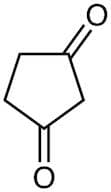
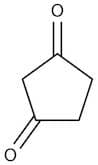
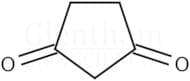
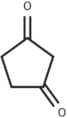
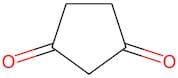
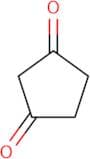
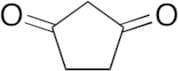
CAS 3859-41-4
:1,3-Cyclopentandion
- 1,3-Cyclopentadione
- 3-Hydroxycyclopent-2-En-1-One
- Cyclopentane-1,3-Dione
- Cyclopentanedione
- NSC 364015
- 1,3-Cyclopentanedione
1,3-Cyclopentanedione
CAS:Formel:C5H6O2Reinheit:>98.0%(GC)Farbe und Form:White to Light yellow to Light orange powder to crystalMolekulargewicht:98.101,3-Cyclopentanedione, 98%
CAS:1,3 cyclopentanedione is used in the synthesis of pgd2 . Reatant in the synthesis of fused dihydrofuran. This Thermo Scientific Chemicals brand product was originally part of the Alfa Aesar product portfolio. Some documentation and label information may refer to the legacy brand. The original AlfaFormel:C5H6O2Reinheit:98%Farbe und Form:Crystals or powder or crystalline powder, Cream to yellow to brownMolekulargewicht:98.101,3-Cyclopentanedione
CAS:Formel:C5H6O2Reinheit:(HPLC) ≥ 97.0%Farbe und Form:Light yellow to yellow or brown powderMolekulargewicht:98.101,3-Cyclopentanedione
CAS:1,3-Cyclopentanedione is a cyclic β-diketone, widely used in biochemical experiments and drug synthesis research.Formel:C5H6O2Farbe und Form:SolidMolekulargewicht:98.1Cyclopentane-1,3-dione
CAS:Cyclopentane-1,3-dioneFormel:C5H6O2Reinheit:97%Farbe und Form: brown solidMolekulargewicht:98.10g/mol1,3-Cyclopentanedione
CAS:1,3-Cyclopentanedione is a tetronic acid that is structurally related to malonic acid. It has been shown to have insulin sensitizing effects in rats, and it may also have anti-inflammatory properties. 1,3-Cyclopentanedione can be synthesized by the reaction of methylene with malonic acid. This reaction proceeds through an aldol cyclization mechanism and results in the formation of an active methylene analog of the original molecule. The product can be hydrolyzed by hydrochloric acid or trifluoroacetic acid to yield the corresponding carboxylic acid.
Molecular modeling studies indicate that 1,3-cyclopentanedione binds to ATPase/kinase (AMPK) and inhibits its activity as well as its ability to phosphorylate downstream targets such as acetyl-CoA carboxylase (ACC) and fatty acid synthase (FAS). These findings support the hypothesisFormel:C5H6O2Reinheit:Min. 95%Farbe und Form:Yellow PowderMolekulargewicht:98.1 g/mol1,3-Cyclopentanedione
CAS:Formel:C5H6O2Reinheit:96%Farbe und Form:Solid, Light brown powderMolekulargewicht:98.1011,3-Cyclopentanedione
CAS:Kontrolliertes ProduktApplications 1,3-Cyclopentanedione was used in the synthesis of chemical probes for selective labeling of sulfenic acid proteins. It was also used to synthesize enaminones with possible anticonvulsant activity.
References Qian, J., et al.: Chem. Comm., 47, 9203 (2011); Scott, K., et al.: J. Med. Chem., 36, 1947 (1993)Formel:C5H6O2Farbe und Form:NeatMolekulargewicht:98.1