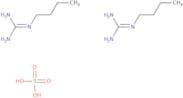
CAS 3867-74-1
:2-Butylguanidinsulfat (2:1)
Beschreibung:
2-Butylguanidinsulfat (2:1) ist eine organische Verbindung, die durch ihre Guanidinstruktur gekennzeichnet ist, die eine Butylgruppe, die am Stickstoffatom befestigt ist, aufweist. Diese Verbindung tritt typischerweise als weißer kristalliner Feststoff auf und ist in Wasser löslich, was sie in verschiedenen Anwendungen nützlich macht, einschließlich als Reagenz in der organischen Synthese und in biologischen Studien. Die Sulfatkomponente zeigt an, dass sie ein Salz mit Schwefelsäure bildet, was ihre Löslichkeit und Stabilität in wässrigen Umgebungen erhöht. 2-Butylguanidin ist bekannt für seine Basizität aufgrund der Anwesenheit der Guanidin-Funktionalgruppe, die an Protonentransferreaktionen teilnehmen kann. Darüber hinaus kann es biologische Aktivität zeigen, die physiologische Prozesse beeinflusst, obwohl die spezifischen Effekte je nach Konzentration und Kontext variieren können. Sicherheitsdaten sollten konsultiert werden, wie bei jeder chemischen Substanz, um ihren Umgang, potenzielle Gefahren und Umweltauswirkungen zu verstehen. Insgesamt dient 2-Butylguanidinsulfat als vielseitige Verbindung in sowohl Forschungs- als auch Industrieanwendungen.
Formel:C10H28N6O4S
InChl:InChI=1/2C5H13N3.H2O4S/c2*1-2-3-4-8-5(6)7;1-5(2,3)4/h2*2-4H2,1H3,(H4,6,7,8);(H2,1,2,3,4)
Sortieren nach
Reinheit (%)
0
100
|
0
|
50
|
90
|
95
|
100
1 Produkte.
Bis(1-butylguanidine), sulfuric acid
CAS:Bis(1-butylguanidine), sulfuric acid (BBSS) is a disinfectant that belongs to the group of isothiocyanates. It has been shown to be an effective fungicide and bactericide in the treatment of herpesvirus infections. BBSS causes death of cells by reacting with and destroying their DNA, which is important for the production of new cell material. The reaction also results in the formation of hydroxyl radicals, which are highly reactive and destructive molecules that can damage other biomolecules such as proteins and lipids. This chemical also acts as an anesthetic by blocking nerve transmissions in certain regions of the body, such as the brain or spinal cord.Formel:C10H28N6O4SReinheit:Min. 95%Molekulargewicht:328.44 g/mol