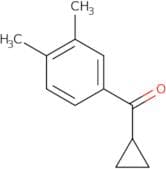
CAS 38675-78-4
:Cyclopropyl(3,4-dimethylphenyl)methanon
Beschreibung:
Cyclopropyl(3,4-dimethylphenyl)methanon, mit der CAS-Nummer 38675-78-4, ist eine organische Verbindung, die durch ihre einzigartige Struktur gekennzeichnet ist, die eine Cyclopropylgruppe und eine Ketongruppe umfasst, die an ein 3,4-Dimethylphenyl-Moiety gebunden ist. Diese Verbindung zeigt typischerweise ein kristallines Aussehen von Weiß bis Hellgelb. Sie ist bekannt für ihre potenziellen Anwendungen in der organischen Synthese und als Zwischenprodukt in der Herstellung verschiedener Arzneimittel und Agrochemikalien. Die Anwesenheit der Cyclopropylgruppe trägt zu ihrer Reaktivität bei und beeinflusst oft die Stabilität der Verbindung sowie ihre Wechselwirkung mit anderen chemischen Spezies. Darüber hinaus kann die Dimethylsubstitution am Phenylring ihre elektronischen Eigenschaften beeinflussen und möglicherweise ihre Reaktivität in elektrophilen aromatischen Substitutionsreaktionen erhöhen. Wie bei vielen organischen Verbindungen können ihre Löslichkeit, Schmelzpunkt und Siedepunkt je nach Umweltbedingungen und Reinheit variieren. Sicherheitsdaten sollten für den Umgang und die Lagerung konsultiert werden, da sie Gesundheitsrisiken darstellen können, wenn sie nicht ordnungsgemäß verwaltet werden.
Formel:C12H14O
InChl:InChI=1S/C12H14O/c1-8-3-4-11(7-9(8)2)12(13)10-5-6-10/h3-4,7,10H,5-6H2,1-2H3
InChI Key:InChIKey=RVHOLOURUAQTTL-UHFFFAOYSA-N
SMILES:C(=O)(C1=CC(C)=C(C)C=C1)C2CC2
Synonyme:- Cyclopropyl 3,4-dimethylphenyl ketone
- Cyclopropyl(3,4-Dimethylphenyl)Methanone
- Ketone, cyclopropyl 3,4-xylyl
- Methanone, cyclopropyl(3,4-dimethylphenyl)-
- NSC 71983
- Cyclopropyl 3,4-xylyl ketone
Sortieren nach
Reinheit (%)
0
100
|
0
|
50
|
90
|
95
|
100
2 Produkte.
Cyclopropyl(3,4-dimethylphenyl)methanone
CAS:<p>Cyclopropyl(3,4-dimethylphenyl)methanone (CPM) is a synthetic cannabinoid that has been shown to have similar effects to the natural cannabinoids found in cannabis. CPM binds to and activates the CB2 receptor, which is found on cells of the immune system, brain, and other organs. It has been studied for its ability to reduce glioma tumor growth in mice by inhibiting glutamate release. The molecular modeling study showed that CPM binds to the receptor with a geometry similar to other CB2 agonists like JWH-133. In addition, CPM inhibits locomotor activity in rats and has been shown to produce some symptoms of anxiety in mice. A receptor knockout study with mice showed that CPM can bind to CB2 receptors without activating them. X-ray diffraction data indicated that CPM is an achiral molecule with an idealized molecular geometry of "s".</p>Formel:C12H14OReinheit:Min. 95%Molekulargewicht:174.24 g/mol