CAS 38937-80-3
:Glycin, Glycylglycyl-N-methyl-
Beschreibung:
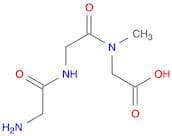
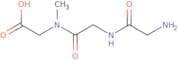
Glycin, Glycylglycyl-N-methyl- ist eine synthetische Verbindung, die zur Klasse der Aminosäuren und Peptide gehört. Sie ist durch das Vorhandensein eines Glycin-Rückgrats gekennzeichnet, das die einfachste Aminosäure ist, und weist eine Methylgruppe auf, die an das Stickstoffatom der Peptidbindung gebunden ist. Diese Modifikation kann ihre Löslichkeit und biologische Aktivität beeinflussen. Die Verbindung hat typischerweise ein weißes bis off-white Aussehen und ist in Wasser löslich, was sie für verschiedene biochemische Anwendungen geeignet macht. Glycin-Derivate werden oft hinsichtlich ihrer Rolle bei der Proteinsynthese, der Neurotransmission und als potenzielle therapeutische Mittel untersucht. Das Vorhandensein der N-Methylgruppe kann ihre Stabilität erhöhen und ihre Wechselwirkung mit biologischen Systemen verändern. Wie viele Aminosäurederivate kann sie Eigenschaften wie geringe Toxizität und Biokompatibilität aufweisen, was sie in pharmazeutischen und ernährungswissenschaftlichen Kontexten von Interesse macht. Spezifische Anwendungen und Wirkungen würden jedoch von weiteren Forschungen und Charakterisierungen dieser Verbindung abhängen.
Formel:C7H13N3O4
InChl:InChI=1S/C7H13N3O4/c1-10(4-7(13)14)6(12)3-9-5(11)2-8/h2-4,8H2,1H3,(H,9,11)(H,13,14)
InChI Key:InChIKey=WTUVOOODVFIARR-UHFFFAOYSA-N
SMILES:C(N(CC(O)=O)C)(CNC(CN)=O)=O
Synonyme:- 2-[2-(2-Aminoacetamido)-N-methylacetamido]acetic acid
- NSC 334197
- Glycine, glycylglycyl-N-methyl-
- Glycylglycylsarcosine
- Glycine, N-(N-glycylglycyl)-N-methyl-
Sortieren nach
Reinheit (%)
0
100
|
0
|
50
|
90
|
95
|
100
3 Produkte.
H-Gly-Gly-Sar-OH
CAS:Kontrolliertes ProduktFormel:C7H13N3O4Farbe und Form:NeatMolekulargewicht:203.196H-Gly-Gly-Sar-OH
CAS:Gly-Gly-Sar is a synthetic peptide that acts as a substrate for the peptide transporter, which is part of the membrane of cells. It is an amide with a reactive group that can form a ternary complex with two hydroxyl ions and one proton. Gly-Gly-Sar has been shown to be taken up by caco-2 cells in an extravesicular manner and undergoes proteolysis by peptidases. This leads to bond cleavage and formation of free Gly-Gly and Sar. The free Gly and Gly are then transported across the cell membrane into the cell cytoplasm, where they are hydroxylated by enzymes such as glycyl-l-leucine hydroxylase to form glycolic acid and glyoxylic acid, respectively.
Formel:C7H13N3O4Reinheit:Min. 95%Molekulargewicht:203.2 g/mol