


CAS 38964-22-6
:2,8-Dichlordibenzo-p-dioxin
Beschreibung:
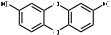
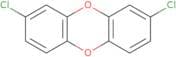
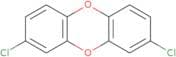
2,8-Dichlordibenzo-p-dioxin (CAS 38964-22-6) ist eine chlorierte organische Verbindung, die zur Klasse der Dioxine gehört, die für ihre Umweltpersistenz und potenzielle Toxizität bekannt sind. Diese Verbindung weist eine Dioxinstruktur auf, die durch zwei Benzolringe gekennzeichnet ist, die durch zwei Sauerstoffatome verbunden sind, mit Chlor-Substituenten an den Positionen 2 und 8. Es handelt sich um einen farblosen bis blassgelben Feststoff, der in Wasser unlöslich, aber in organischen Lösungsmitteln löslich ist. 2,8-Dichlordibenzo-p-dioxin ist von besonderem Interesse aufgrund seines Potenzials als Kontaminant in verschiedenen industriellen Prozessen und seiner Assoziation mit nachteiligen gesundheitlichen Auswirkungen, einschließlich Karzinogenität und endokriner Störung. Die Verbindung entsteht typischerweise als Nebenprodukt bei der Verbrennung chlorierter organischer Materialien und während der Herstellung bestimmter Herbizide und Pestizide. Aufgrund ihrer Stabilität und Bioakkumulationspotenzials stellt sie erhebliche Umwelt- und Gesundheitsrisiken dar, was zu strengen Vorschriften hinsichtlich ihrer Freisetzung und Handhabung führt.
Formel:C12H6Cl2O2
InChl:InChI=1S/C12H6Cl2O2/c13-7-1-3-9-11(5-7)16-12-6-8(14)2-4-10(12)15-9/h1-6H
InChI Key:InChIKey=WMWJCKBJUQDYLM-UHFFFAOYSA-N
SMILES:ClC=1C=C2C(OC=3C(O2)=CC(Cl)=CC3)=CC1
Synonyme:- 2,8-Dichlordibenzo-p-dioxin
- 2,8-Dichloro-dibenzo[1,4]dioxin
- 2,8-Dichlorodibenzo-p-dioxin
- 2,8-Dichlorodibenzo[b,e][1,4]dioxin
- 2,8-Dichlorodibenzodioxin
- 3,6-Dichloro-9,10-dioxaanthracene
- Dibenzo[B,E][1,4]Dioxin, 2,8-Dichloro-
- Pcdd 12
- 2,8-Dichlorooxanthrene
Sortieren nach
Reinheit (%)
0
100
|
0
|
50
|
90
|
95
|
100
5 Produkte.
2,8-Dichlorodibenzo-p-dioxin
CAS:2,8-Dichlorodibenzo-p-dioxin (2,8-DCDD) is a chlorinated dioxin. It is used as an analytical reagent in wastewater treatment methods. 2,8-DCDD can be prepared by the reaction of chlorine atoms with a sample that contains dioxins. The preparation of 2,8-DCDD involves the use of solvents such as dichloromethane or toluene and has been shown to require activation energies between 10 and 40 kcal/mol. 2,8-DCDD is a postulated carcinogen because it binds to receptor sites on cells and promotes tumor formation in animal models. The rate of formation of 2,8-DCDD has been shown to increase when triclosan is present in the environment at concentrations greater than 0.1 ppm. Triclosan can also promote the formation of 2,6-dichlorophenolFormel:C12H6Cl2O2Reinheit:Min. 95%Molekulargewicht:253.08 g/mol2,8-Dichlorodibenzo-p-dioxin
CAS:2,8-Dichlorodibenzo-p-dioxin is a high quality chemical that is used as a building block in the synthesis of more complex compounds. It can be used as a reagent and speciality chemical, as well as being a versatile intermediate in organic synthesis. The CAS number for 2,8-Dichlorodibenzo-p-dioxin is 38964-22-6.Formel:C12H6Cl2O2Reinheit:Min. 95.0 Area-%Molekulargewicht:253.08 g/molRef: 3D-J-200144
10mgNachfragen25mgNachfragen50mgNachfragen100mgNachfragen250mgNachfragen-Unit-ggNachfragen2,8-Dichlorodibenzo[b,e][1,4]dioxin
CAS:Kontrolliertes Produkt<p>Applications 2,8-Dichlorodibenzo[b,e][1,4]dioxin is a standard used for environmental testing and research such as the study of hydrophobic organic contaminants in river water.<br>References Khairy, M. et al.: Env. Sci. Tech., 48, 2533 (2014);<br></p>Formel:C12H6Cl2O2Farbe und Form:NeatMolekulargewicht:253.08


![2,8-Dichlorodibenzo[b,e][1,4]dioxin](/_next/image/?url=https%3A%2Fstatic.cymitquimica.com%2Fproducts%2FTR%2Fthumb%2FD436513.jpg&w=3840&q=75)


