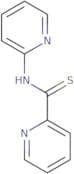
CAS 39122-38-8
:N-(pyridin-2-yl)pyridin-2-carbothioamid
Beschreibung:
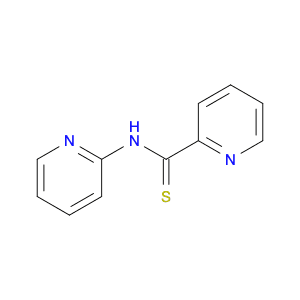
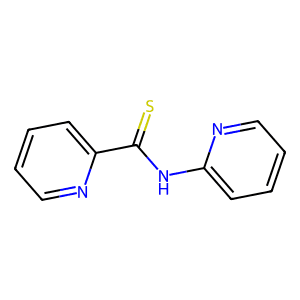
N-(pyridin-2-yl)pyridin-2-carbothioamid, mit der CAS-Nummer 39122-38-8, ist eine chemische Verbindung, die durch ihre einzigartige Struktur gekennzeichnet ist, die zwei Pyridinringe und eine Carbothioamid-Funktionalgruppe umfasst. Diese Verbindung zeigt typischerweise Eigenschaften, die mit heterocyclischen Verbindungen assoziiert sind, wie eine moderate Löslichkeit in polaren Lösungsmitteln und das Potenzial für Wasserstoffbrückenbindungen aufgrund der Anwesenheit der Amidgruppe. Die Anwesenheit der Pyridinringe trägt zu ihrem aromatischen Charakter bei, was ihre Reaktivität und Stabilität beeinflussen kann. Darüber hinaus können Verbindungen wie diese biologische Aktivität zeigen, was sie in der medizinischen Chemie und der Arzneimittelentwicklung von Interesse macht. Die Thioamid-Funktionalgruppe kann auch eine ausgeprägte chemische Reaktivität verleihen, wie die Fähigkeit, an nucleophilen Reaktionen teilzunehmen. Insgesamt ist N-(pyridin-2-yl)pyridin-2-carbothioamid eine vielseitige Verbindung mit potenziellen Anwendungen in verschiedenen Bereichen, einschließlich Pharmazie und Materialwissenschaft.
Formel:C11H9N3S
InChl:InChI=1/C11H9N3S/c15-11(9-5-1-3-7-12-9)14-10-6-2-4-8-13-10/h1-8H,(H,13,14,15)
SMILES:c1ccnc(c1)C(=Nc1ccccn1)S
Synonyme:- 2-pyridinecarbothioamide, N-2-pyridinyl-
Sortieren nach
Reinheit (%)
0
100
|
0
|
50
|
90
|
95
|
100
6 Produkte.
N-(Pyridin-2-yl)pyridine-2-carbothioamide
CAS:Formel:C11H9N3SReinheit:98%Farbe und Form:SolidMolekulargewicht:215.2743NSC 185058
CAS:NSC 185058 is an inhibitor of ATG4B, a major cysteine protease. It also can attenuate the autophagic activity.Formel:C11H9N3SReinheit:99.27%Farbe und Form:SolidMolekulargewicht:215.27NSC 185058
CAS:NSC 185058 is a potential cancer therapy that inhibits protein synthesis in the cell. It prevents cells from growing and dividing by inhibiting their ability to synthesize proteins. NSC 185058 also induces apoptotic cell death, which is programmed cell death that occurs as a result of genetic or environmental stress. When cells undergo apoptosis, they are able to destroy themselves without releasing harmful substances into the surrounding area. NSC 185058 has been shown to induce autophagy and autophagy-related proteins in animal models. Autophagy is a process by which cells break down dysfunctional components to recycle nutrients and energy for future use. NSC 185058 has also been shown to inhibit tumor growth in mice with malignant brain tumors when used in combination with other therapies such as radiation and chemotherapy.Formel:C11H9N3SReinheit:Min. 95%Molekulargewicht:215.27 g/mol