CAS 392-12-1
:Indol-3-pyruvinsäure
Beschreibung:
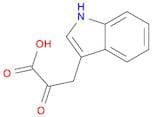
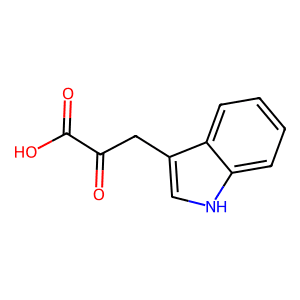
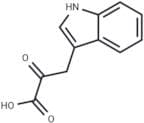
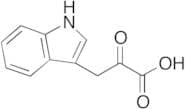
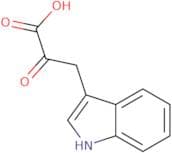
Indol-3-pyruvinsäure (IPA) ist eine organische Verbindung, die zur Klasse der Indolderivate gehört und durch ihre Struktur gekennzeichnet ist, die einen Indolring und eine pyruvische Säuregruppe umfasst. Es handelt sich um eine natürlich vorkommende Verbindung, die in verschiedenen Pflanzen gefunden wird und bekannt ist für ihre Rolle als Vorläufer in der Biosynthese von Auxinen, die essentielle Pflanzenhormone sind, die Wachstum und Entwicklung regulieren. IPA ist typischerweise ein weißer bis off-white kristalliner Feststoff, der in Wasser und organischen Lösungsmitteln löslich ist und einen Schmelzpunkt aufweist, der je nach Reinheit variiert. Die Verbindung hat in der Forschung Interesse geweckt, aufgrund ihrer potenziellen Anwendungen in der Landwirtschaft und Medizin, insbesondere in der Regulierung des Pflanzenwachstums und als mögliches therapeutisches Mittel. Ihre biologischen Aktivitäten umfassen antioxidative Eigenschaften und potenzielle Auswirkungen auf zelluläre Signalwege. Wie bei vielen organischen Verbindungen sollte IPA mit Vorsicht behandelt werden, wobei geeignete Sicherheitsrichtlinien beachtet werden sollten, um Risiken im Zusammenhang mit seiner Verwendung zu mindern.
Formel:C11H9NO3
InChl:InChI=1S/C11H9NO3/c13-10(11(14)15)5-7-6-12-9-4-2-1-3-8(7)9/h1-4,6,12H,5H2,(H,14,15)
InChI Key:InChIKey=RSTKLPZEZYGQPY-UHFFFAOYSA-N
SMILES:C(C(C(O)=O)=O)C=1C=2C(NC1)=CC=CC2
Synonyme:- 1H-Indole-3-propanoic acid, α-oxo-
- 1H-Indole-3-pyruvic acid
- 3-(1H-indol-3-yl)-2-oxopropanoate
- 3-(1H-indol-3-yl)-2-oxopropanoic acid
- 3-(3-Indolyl)-2-Oxopropanoic Acid
- 3-(3-Indolyl)pyruvic acid
- 3-Indolylpyroracemic acid
- 3-Indolylpyruvic acid
- 5-Iodophthalide
- Indole-3-(2-Oxo)-Propanoic Acid
- Indole-3-Pyruvic Acid Monohydrate
- Indole-3-pyruvate
- Indolepyruvic acid
- Indolyl-3-pyruvate
- NSC 88874
- Pol 240
- alpha-Oxo-1H-indole-3-propanoic acid
- α-Oxo-1H-indole-3-propanoic acid
- β-Indolepyruvic acid
- β-Indolylpyruvic acid
- Weitere Synonyme anzeigen
Sortieren nach
Reinheit (%)
0
100
|
0
|
50
|
90
|
95
|
100
10 Produkte.
3-(1H-indol-3-yl)-2-oxopropanoic acid
CAS:Formel:C11H9NO3Reinheit:95%Farbe und Form:SolidMolekulargewicht:203.1941Indole-3-pyruvic acid
CAS:Indole-3-pyruvic acidFormel:H2Farbe und Form: light yellow powderMolekulargewicht:203.19g/molIndole-3-pyruvic acid
CAS:Indole-3-pyruvic acid is a precursor for the plant growth hormone indole-3-acetic acid.Formel:C11H9NO3Reinheit:98.89% - 99.21%Farbe und Form:Off White CrystalsMolekulargewicht:203.19Indole-3-pyruvic Acid
CAS:Applications Indole-3-pyruvic Acid is a compound involved in the biosynthesis of Indole-3-acetic acid, a plant hormone which plays important roles in regulating growth and responses to environmental changes.
References Kong, W., et al.: Plant Cell Physiol, 56, 715-726 (2015)Formel:C11H9NO3Farbe und Form:Light Yellow To BeigeMolekulargewicht:203.19Indole-3-pyruvic acid
CAS:Thiostrepton is an antibiotic that inhibits the synthesis of proteins by binding to the α subunit of the bacterial ribosome. It also has a polymerase chain reaction (PCR) amplification activity. Thiostrepton's inhibitory effect on protein synthesis is due to its ability to bind to the α subunit of the ribosome, which results in inhibition of enzyme activities and physiological function. The thiostrepton-resistant mutants have been found in skin cells and plants. The resistant mutants are mostly due to point mutations in amino acid residues on the surface of the ribosomal target site, which alters its affinity for thiostrepton. This antibiotic has been shown to be active against wild-type strains of bacteria, as well as methicillin-resistant Staphylococcus aureus (MRSA). Thiostrepton's active form is metabolized through hydroxylation and conjugation with glutathione or glucurFormel:C11H9NO3Reinheit:Area-% Min. 95 Area-%Farbe und Form:Off-White Yellow PowderMolekulargewicht:203.20 g/mol3-(1H-Indol-3-yl)-2-oxopropanoic acid
CAS:Formel:C11H9NO3Reinheit:95%Farbe und Form:SolidMolekulargewicht:203.197