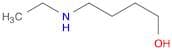
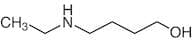
CAS 39216-86-9
:Ethylaminobutanol; 95%
Beschreibung:
Ethyaminobutanol, mit der CAS-Nummer 39216-86-9, ist eine organische Verbindung, die durch ihre Amin- und Alkoholgruppen charakterisiert ist. Es erscheint typischerweise als farblose bis blassgelbe Flüssigkeit mit einem charakteristischen Amin-Geruch. Diese Verbindung ist in Wasser und organischen Lösungsmitteln löslich, was sie vielseitig für verschiedene Anwendungen macht. Ethylaminobutanol wird hauptsächlich in der Synthese von Arzneimitteln, Agrochemikalien und als Baustein in der organischen Chemie verwendet. Seine Struktur ermöglicht es ihm, an verschiedenen chemischen Reaktionen teilzunehmen, einschließlich nucleophiler Substitutionen und Kondensationsreaktionen. Das Vorhandensein sowohl einer Aminogruppe als auch einer Hydroxylgruppe trägt zu seiner Reaktivität und seinem Potenzial als Tensid oder Emulgator bei. Sicherheitsüberlegungen umfassen den Umgang in gut belüfteten Bereichen und die Verwendung geeigneter persönlicher Schutzausrüstung, da es Haut- und Augenreizungen verursachen kann. Insgesamt ist Ethylaminobutanol eine wertvolle Verbindung in der chemischen Synthese und industriellen Anwendungen aufgrund seiner einzigartigen Eigenschaften.
Formel:C6H15NO
InChl:InChI=1/C6H15NO/c1-2-7-5-3-4-6-8/h7-8H,2-6H2,1H3
SMILES:CCNCCCCO
Synonyme:- 4-Ethylamino-1-butanol
- 4-(Ethylamino)Butan-1-Ol
Sortieren nach
Reinheit (%)
0
100
|
0
|
50
|
90
|
95
|
100
5 Produkte.
4-Ethylamino-1-butanol
CAS:Formel:C6H15NOReinheit:>98.0%(T)Farbe und Form:Colorless to Light yellow clear liquidMolekulargewicht:117.194-Ethylamino-1-butanol
CAS:Formel:C6H15NOReinheit:98%Farbe und Form:Liquid, ClearMolekulargewicht:117.1924-Ethylamino-1-butanol
CAS:<p>4-Ethylamino-1-butanol is an alkanolamine that interacts with receptors in the body. It has a hydroxyl group and is a molecule that contains functionalities. It interacts with other molecules, such as corticotropin-releasing hormone (CRH). 4-Ethylamino-1-butanol binds to CRH and prevents it from binding to its receptor, which decreases the release of corticotropin. This compound has been used as a positron emission tomography (PET) radiotracer for imaging the insulin receptor in living tissue. The chemical can be systematically introduced into tissues and organs, including the brain, where it accumulates due to its hydrophilic nature. 4-Ethylamino-1-butanol also has oxygenated groups that are suitable for PET imaging using 18F radiolabeling.</p>Formel:C6H15NOReinheit:Min. 95%Molekulargewicht:117.19 g/mol