CAS 39751-33-2
:Chloramphenicol-3-Glucuronid
Beschreibung:
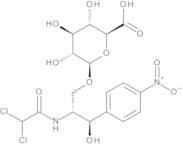
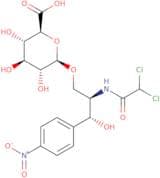
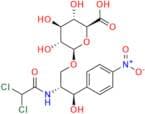
Chloramphenicol-3-Glucuronid ist ein Metabolit des Antibiotikums Chloramphenicol, das für seine breit gefächerten antibakteriellen Eigenschaften bekannt ist. Diese Verbindung entsteht durch den Glucuronidierungsprozess, bei dem eine Glucuronsäureeinheit mit Chloramphenicol konjugiert wird, was dessen Löslichkeit erhöht und die Ausscheidung aus dem Körper erleichtert. Die chemische Struktur von Chloramphenicol-3-Glucuronid umfasst eine Glucuronsäureeinheit, die mit dem Chloramphenicol-Molekül verbunden ist, was seine pharmakokinetischen Eigenschaften im Vergleich zur Ausgangsverbindung verändert. Es wird typischerweise in biologischen Proben, wie Urin, nach der Verabreichung von Chloramphenicol gefunden und wird als Biomarker für die Exposition gegenüber Chloramphenicol verwendet. Die Verbindung zeichnet sich durch ihre relativ hohe Polarität aus, die ihre Wechselwirkung mit biologischen Systemen und ihre Eliminationswege beeinflusst. Während Chloramphenicol selbst mit potenziellen Nebenwirkungen, einschließlich der Unterdrückung des Knochenmarks, verbunden ist, wird Chloramphenicol-3-Glucuronid im Allgemeinen als weniger toxisch angesehen. Seine Untersuchung ist wichtig in der Pharmakologie und Toxikologie, insbesondere um den Arzneimittelstoffwechsel und die Sicherheitsprofile von Chloramphenicol zu verstehen.
Formel:C17H20Cl2N2O11
InChl:InChI=1S/C17H20Cl2N2O11/c18-14(19)15(26)20-8(9(22)6-1-3-7(4-2-6)21(29)30)5-31-17-12(25)10(23)11(24)13(32-17)16(27)28/h1-4,8-14,17,22-25H,5H2,(H,20,26)(H,27,28)/t8-,9-,10+,11+,12-,13+,17-/m1/s1
InChI Key:InChIKey=UARPTSDFEIFMJP-PEXHWNMISA-N
SMILES:O(C[C@H]([C@H](O)C1=CC=C(N(=O)=O)C=C1)NC(C(Cl)Cl)=O)[C@@H]2O[C@H](C(O)=O)[C@@H](O)[C@H](O)[C@H]2O
Synonyme:- β-D-Glucopyranosiduronic acid, (2R,3R)-2-[(dichloroacetyl)amino]-3-hydroxy-3-(4-nitrophenyl)propyl
- (2R,3R)-2-[(2,2-Dichloroacetyl)amino]-3-hydroxy-3-(4-nitrophenyl)propyl β-D-glucopyranosiduronic acid
- β-D-Glucopyranosiduronic acid, (2R,3R)-2-[(2,2-dichloroacetyl)amino]-3-hydroxy-3-(4-nitrophenyl)propyl
- β-D-Glucopyranosiduronic acid, 2-[(dichloroacetyl)amino]-3-hydroxy-3-(4-nitrophenyl)propyl, [R-(R*,R*)]-
- Glucopyranosiduronic acid, 2-(2,2-dichloroacetamido)-3-hydroxy-3-(p-nitrophenyl)propyl, β-D-
Sortieren nach
Reinheit (%)
0
100
|
0
|
50
|
90
|
95
|
100
5 Produkte.
Chloramphenicol 3-O-β-D-Glucuronide
CAS:Applications The major glucuronide metabolite of Chloramphenicol (C325030).
References Simons, P., et al.: Xenobiotica, 22, 1267 (1992), Kaji, H., et al.: Drug Metab. Dispos., 33, 60 (2005),Formel:C17H20Cl2N2O11Farbe und Form:Off-WhiteMolekulargewicht:499.25Chloramphenicol glucuronide
CAS:Chloramphenicol glucuronide is an active metabolite of chloramphenicol. It can be detected in human serum and urine, as well as rat liver microsomes. Chloramphenicol glucuronide binds to the cytosolic protein, cytochrome b5 reductase, which inhibits protein synthesis and cell growth. This compound has been shown to be effective for treating infectious diseases such as typhoid fever, pelvic inflammatory disease, and pneumonia. The chloramphenicol glucuronide group also includes a number of other metabolites that are formed from chloramphenicol by conjugation with glucuronic acid.Formel:C17H20Cl2N2O11Reinheit:Min. 95 Area-%Farbe und Form:PowderMolekulargewicht:499.26 g/molChloramphenicol 3-O-b-D-Glucuronide Sodium Salt
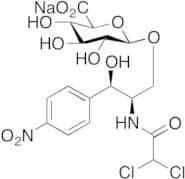
CAS:Kontrolliertes ProduktApplications Chloramphenicol 3-O-β-D-Glucuronide is the major glucuronide metabolite of Chloramphenicol (C325030).
References Simons, P., et al.: Xenobiotica, 22, 1267 (1992); Kaji, H., et al.: Drug Metab. Dispos., 33, 60 (2005)Formel:C17H19Cl2N2NaO11Farbe und Form:NeatMolekulargewicht:521.24