CAS 4004-95-9
:Piperazin, 1-phenyl-, hydrochlorid (1:2)
Beschreibung:
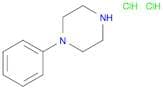
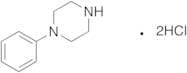
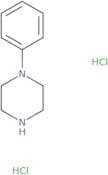
Piperazin, 1-phenyl-, hydrochlorid (1:2) ist eine chemische Verbindung, die zur Klasse der Piperazinderivate gehört. Sie ist durch das Vorhandensein eines Piperazinsrings gekennzeichnet, der eine sechsgliedrige heterocyclische Struktur mit zwei Stickstoffatomen ist. Die Verbindung wird typischerweise als Hydrochloridsalz angetroffen, was ihre Löslichkeit in Wasser erhöht und sie für verschiedene Anwendungen geeignet macht. Diese Substanz wird häufig in pharmazeutischen Formulierungen verwendet und kann biologische Aktivität zeigen, einschließlich potenzieller Auswirkungen auf das zentrale Nervensystem. Ihre molekulare Struktur ermöglicht Wechselwirkungen mit verschiedenen Rezeptoren, was in der medizinischen Chemie von Interesse sein kann. Die Verbindung ist unter Standardbedingungen im Allgemeinen stabil, sollte jedoch mit Vorsicht behandelt werden, wie alle chemischen Substanzen, um Exposition oder unerwünschte Reaktionen zu vermeiden. Eine ordnungsgemäße Lagerung an einem kühlen, trockenen Ort wird empfohlen, um ihre Integrität zu bewahren. Wie bei jedem Chemikalien sollten Sicherheitsdatenblätter für Handhabungs- und Entsorgungsrichtlinien konsultiert werden.
Formel:C10H14N2·2ClH
InChl:InChI=1S/C10H14N2.2ClH/c1-2-4-10(5-3-1)12-8-6-11-7-9-12;;/h1-5,11H,6-9H2;2*1H
InChI Key:InChIKey=CUTPTQNQXVVRDB-UHFFFAOYSA-N
SMILES:C1(=CC=CC=C1)N2CCNCC2.Cl
Synonyme:- 1-Phenylpiperazine HCl
- Piperazine, 1-phenyl-, dihydrochloride
- Piperazine, 1-phenyl-, hydrochloride (1:2)
- 1-Phenylpiperazine dihydrochloride
Sortieren nach
Reinheit (%)
0
100
|
0
|
50
|
90
|
95
|
100
4 Produkte.
1-Phenylpiperazine Dihydrochloride
CAS:Formel:C10H16Cl2N2Farbe und Form:SolidMolekulargewicht:235.15341-Phenylpiperazine Dihydrochloride
CAS:Kontrolliertes ProduktStability Hygroscopic
Applications 1-Phenylpiperazine was tested for its activity as a topical glaucoma agent.
References Blevins, W., et al.: J. Bacteriol., 112, 513 (1972), Cohen, M., et al.: J. Pharmacol. Exp. Ther., 223, 110 (1982), Parshikov, I., et al.: Appl. Microbiol. Biotechnol., 56, 474 (2001),Formel:C10H14N2·2ClHFarbe und Form:Off-WhiteMolekulargewicht:235.151-Phenylpiperazine-d4
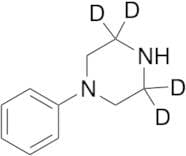
CAS:Kontrolliertes ProduktApplications Labelled 1-Phenylpiperazine (P336040). A class of entactogenic drugs, with possible side effects like headache, nausea or vomiting, agitation, sedation, sexual dysfunction and cardiac death and ventricular arrhythmia.
References Anderson, H. et al.: Clinical Therapeutics, 34, 113 (2012); Hill, S. & Thomas, S.: Clinical Toxicol., 49, 705 (2011); Leonard, C. et al.: Pharmacoepidem. Dr. S., 20, 903 (2011)Formel:C10D4H10N2Farbe und Form:NeatMolekulargewicht:166.2561-Phenylpiperazine Dihydrochloride
CAS:Kontrolliertes Produkt1-Phenylpiperazine Dihydrochloride is an analytical reagent that is used for wastewater treatment. It is a weak base and has been found to be active in the treatment of infectious diseases, such as malaria, tuberculosis and hepatitis. 1-Phenylpiperazine Dihydrochloride reacts with nitrogen atoms to form piperazine. This reaction solution can be used to determine the phenylpiperazine concentration by measuring the change in pH. The biological properties of 1-phenylpiperazine dihydrochloride have been shown through mammalian cell culture experiments using human serum, lc-ms/ms method, anhydrous sodium titration calorimetry, and carcinoid syndrome models in mice. 1-Phenylpiperazine dihydrochloride binds to dopamine receptors, inhibiting their activity and reducing the release of dopamine from nerve cells.Formel:C10H16Cl2N2Reinheit:Min. 95%Molekulargewicht:235.15 g/mol