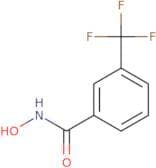
CAS 40069-06-5
:N-hydroxy-3-(trifluormethyl)benzamid
Beschreibung:
N-hydroxy-3-(trifluormethyl)benzamid ist eine organische Verbindung, die durch das Vorhandensein einer Hydroxylamin-Funktionalgruppe (-NHOH) gekennzeichnet ist, die an eine Benzamid-Struktur gebunden ist, spezifisch an der Meta-Position relativ zu einer Trifluormethylgruppe (-CF3). Diese Verbindung zeigt typischerweise Eigenschaften, die sowohl mit den Funktionen von Amiden als auch von Hydroxylaminen verbunden sind, einschließlich potenzieller Reaktivität in nucleophilen Substitutions- und Kondensationsreaktionen. Die Trifluormethylgruppe trägt zur Lipophilie der Verbindung bei und kann ihre elektronischen Eigenschaften beeinflussen, was sie zu einem nützlichen Moiety in der medizinischen Chemie und Materialwissenschaft macht. N-hydroxy-3-(trifluormethyl)benzamid kann auch biologische Aktivität zeigen und möglicherweise als Zwischenprodukt in der Synthese von Arzneimitteln oder Agrochemikalien dienen. Ihre Stabilität, Löslichkeit und Reaktivität können je nach Lösungsmittel und Bedingungen, die in Experimenten verwendet werden, variieren. Wie bei vielen chemischen Substanzen sollten beim Umgang mit dieser Verbindung Sicherheitsvorkehrungen getroffen werden, da sie Gesundheitsrisiken oder Umweltgefahren darstellen kann.
Formel:C8H6F3NO2
Synonyme:- N-hydroxy-3-(trifluoromethyl)benzamide
- Benzamide, N-hydroxy-3-(trifluoromethyl)-
Sortieren nach
Reinheit (%)
0
100
|
0
|
50
|
90
|
95
|
100
1 Produkte.
N-Hydroxy-3-(trifluoromethyl)benzamide
CAS:N-Hydroxymethyl-3-(trifluoromethyl)benzamide is an oxidative and reductive elimination agent that can be used in a variety of synthetic reactions. This compound can be used to synthesize hydroxamic acids, alkenylations, carboxylates, and other functionalized organic compounds. This compound is also useful for the preparation of aromatic carboxylic acid derivatives. The mechanism for this reaction is the hydroxamic acid formation through reductive elimination followed by the addition of an alcohol or amine. The reaction begins with the oxidative cleavage of an ester or amide bond to form a carbonyl group and a hydroxylamine moiety. The hydroxylamine then undergoes reductive elimination to yield a hydroxamic acid. This process is catalyzed by metal ions such as copper (Cu), zinc (Zn), and iron (Fe).Formel:C8H6F3NO2Reinheit:Min. 95%Molekulargewicht:205.13 g/mol