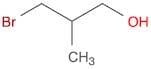
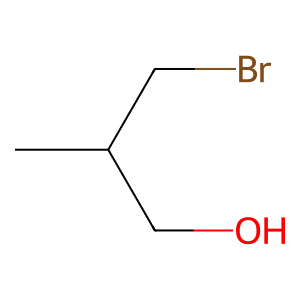
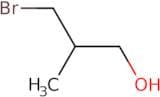
CAS 40145-08-2
:1-Propanol, 3-brom-2-methyl-
Beschreibung:
1-Propanol, 3-brom-2-methyl- ist eine organische Verbindung, die durch ihre Struktur gekennzeichnet ist, die ein Propanol-Rückgrat mit einem Bromatom und einer Methylgruppe umfasst, die jeweils am zweiten und dritten Kohlenstoffatom angebracht sind. Diese Verbindung wird als Bromoalkohol klassifiziert und weist typische Eigenschaften von Alkoholen auf, wie die Fähigkeit, Wasserstoffbrücken zu bilden, was ihre Löslichkeit in Wasser und anderen polaren Lösungsmitteln beeinflusst. Die Anwesenheit des Bromatoms führt zu zusätzlicher Reaktivität, was sie zu einem potenziellen Kandidaten für verschiedene chemische Reaktionen, einschließlich nucleophiler Substitutionen, macht. Ihre molekulare Struktur trägt zu ihren physikalischen Eigenschaften bei, wie Siedepunkten und Schmelzpunkten, die im Allgemeinen von der Größe und der Natur der Substituenten beeinflusst werden. 1-Propanol, 3-brom-2-methyl- kann in der organischen Synthese verwendet werden und kann als Zwischenprodukt bei der Herstellung anderer chemischer Verbindungen dienen. Sicherheitsüberlegungen sollten beim Umgang mit dieser Substanz berücksichtigt werden, da sie gesundheitliche Risiken birgt, die typisch für halogenierte organische Verbindungen sind.
Formel:C4H9BrO
Sortieren nach
Reinheit (%)
0
100
|
0
|
50
|
90
|
95
|
100
4 Produkte.
1-Propanol, 3-bromo-2-methyl-
CAS:Formel:C4H9BrOReinheit:98%Farbe und Form:LiquidMolekulargewicht:153.01773-BROMO-2-METHYLPROPAN-1-OL
CAS:Formel:C4H9BrOReinheit:95%Farbe und Form:LiquidMolekulargewicht:153.0193-Bromo-2-methylpropan-1-ol
CAS:3-Bromo-2-methylpropan-1-ol is a chiral, neurotoxic alcohol. It has been shown to be a precursor for the synthesis of neurotrophic analogues, which are compounds that help maintain the structure and function of neurons, such as 3-bromo-2-methylpropanal (BMPA) and 3-bromoacetophenone. The enantiomers of BMPA have different effects on fetal rat cerebral neuronal cells. One enantiomer inhibits the growth of neurons, while the other promotes their growth. These differences may be related to their optical activity: one enantiomer is active when present in the form of left circularly polarized light and the other is active in right circularly polarized light.
Formel:C4H9BrOReinheit:Min. 95%Molekulargewicht:153.02 g/mol