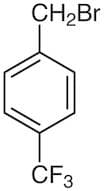
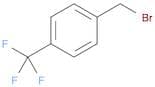
CAS 402-49-3
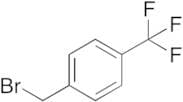
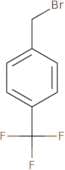
:4-(Trifluormethyl)benzylbromid
- 1-Trifluoromethyl-4-(bromomethyl)benzene
- 4-(Trifluoromethyl)Benzyl Bromide
- 4-Bromomethylbenzotrifluoride
- 4-Trifluoromethylbenzyl Bromide
- Benzene, 1-(bromomethyl)-4-(trifluoromethyl)-
- p-(Trifluoromethyl)benzyl bromide
- p-Xylene, α′-bromo-α,α,α-trifluoro-
- α′-Bromo-α,α,α-trifluoro-p-xylene
- 1-(Bromomethyl)-4-(trifluoromethyl)benzene
4-(Trifluoromethyl)benzyl Bromide
CAS:Formel:C8H6BrF3Reinheit:>98.0%(GC)Farbe und Form:White or Colorless to Light yellow powder to lump to clear liquidMolekulargewicht:239.044-(Trifluoromethyl)benzyl bromide, 98%
CAS:4-(Trifluoromethyl)benzyl bromide can be used to produce p-trifluoromethylbenzyl phenyl sulfide. It is used in medicine. This Thermo Scientific Chemicals brand product was originally part of the Alfa Aesar product portfolio. Some documentation and label information may refer to the legacy brand. TheFormel:C8H6BrF3Reinheit:98%Farbe und Form:Crystals or powder or crystalline powder or fused solid, White to creamMolekulargewicht:239.044-(Trifluoromethyl)benzyl bromide
CAS:Formel:C8H6BrF3Reinheit:98%Farbe und Form:SolidMolekulargewicht:239.03244-(Trifluoromethyl)benzyl bromide
CAS:4-(Trifluoromethyl)benzyl bromideFormel:C8H6BrF3Reinheit:98%Farbe und Form: white to off white fused solidMolekulargewicht:239.03g/mol4-(Trifluoromethyl)benzyl bromide
CAS:Formel:C8H6BrF3Reinheit:98.0%Farbe und Form:Low Melting SolidMolekulargewicht:239.0354-(Trifluoromethyl)benzyl Bromide
CAS:Kontrolliertes ProduktApplications 4-(Trifluoromethyl)benzyl Bromide is a useful building block. It is used in the synthesis of 1-(Substituted benzyl)-2-substituted-5,6-dichlorobenzimidazoles with antiviral activities.It is also used to prepare 2-[(4-diarylmethoxy)phenyl]benzimidazoles as potent inhibitors of hepatitis C virus NS5B polymerase.
Not a dangerous good if item is equal to or less than 1g/ml and there is less than 100g/ml in the package
References Porcari, A., et al.: J. Med. Chem., 41, 1252 (1998); Ishida, T., et al.: Bioorg. Med. Chem. Lett., 16, 1859 (2006)Formel:C8H6BrF3Farbe und Form:NeatMolekulargewicht:239.034-(Trifluoromethyl)benzyl bromide
CAS:4-Trifluoromethylbenzyl bromide is a choline derivative that acts as an anticancer agent. It is structurally similar to the anticancer drug doxorubicin, which has been shown to be effective against breast cancer and leukemia. 4-Trifluoromethylbenzyl bromide interacts with cellular proteins, including choline kinase, and inhibits the mitochondrial pathway. This leads to cell death through apoptosis. The molecule also interacts with nucleotide bases such as thymine and cytosine in DNA, inhibiting transcription and replication. 4-Trifluoromethylbenzyl bromide binds strongly to the hydroxyl group of cholesterol by an electrophilic substitution mechanism to form a covalent bond with its hydroxy group. The molecule can also bind to chloride ions by an ionic bond.
Formel:C8H6BrF3Reinheit:Min. 95%Farbe und Form:White PowderMolekulargewicht:239.03 g/mol