CAS 4023-82-9
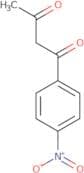
:1-(4-Nitrophenyl)-1,3-butanedion
Beschreibung:
1-(4-Nitrophenyl)-1,3-butanedion, auch bekannt unter seiner CAS-Nummer 4023-82-9, ist eine organische Verbindung, die durch ihre Diketonstruktur gekennzeichnet ist und ein Butandion-Rückgrat aufweist, das mit einer Nitrofenylgruppe substituiert ist. Diese Verbindung zeigt typischerweise ein gelbes kristallines Aussehen aufgrund der Anwesenheit der Nitrogruppe, die ihre elektronischen Eigenschaften und Reaktivität beeinflussen kann. Sie ist bekannt für ihre potenziellen Anwendungen in der organischen Synthese, insbesondere in der Entwicklung von Arzneimitteln und Agrochemikalien, aufgrund ihrer Fähigkeit, an verschiedenen chemischen Reaktionen teilzunehmen, wie nucleophile Additionen und Kondensationsreaktionen. Die Nitrogruppe verstärkt ihren elektrophilen Charakter, was sie zu einem nützlichen Zwischenprodukt bei der Synthese komplexerer Moleküle macht. Darüber hinaus kann 1-(4-Nitrophenyl)-1,3-butanedion interessante photophysikalische Eigenschaften aufweisen, die in der Materialwissenschaft und bei Farbanwendungen untersucht werden können. Wie bei vielen organischen Verbindungen sollte der Umgang mit Vorsicht erfolgen, wobei potenzielle Toxizität und Umweltauswirkungen zu berücksichtigen sind.
Formel:C10H9NO4
InChl:InChI=1S/C10H9NO4/c1-7(12)6-10(13)8-2-4-9(5-3-8)11(14)15/h2-5H,6H2,1H3
InChI Key:InChIKey=UUFHFNDYTYXICJ-UHFFFAOYSA-N
SMILES:C(CC(C)=O)(=O)C1=CC=C(N(=O)=O)C=C1
Synonyme:- (p-Nitrobenzoyl)acetone
- 1,3-Butanedione, 1- (p-nitrophenyl)-
- 1,3-Butanedione, 1-(4-Nitrophenyl)-
- 1-(4-Nitrophenyl)-1,3-butanedione
- 1-(p-Nitrophenyl)-1,3-butanedione
- 4-Nitrobenzoylacetone
- Benzoylacetone, p-nitro-
- NSC 21486
Sortieren nach
Reinheit (%)
0
100
|
0
|
50
|
90
|
95
|
100
1 Produkte.
1-(4-Nitrophenyl)butane-1,3-dione
CAS:1-(4-Nitrophenyl)butane-1,3-dione is a tautomer of 1,4-naphthoquinone. This compound has been reported to have an optical rotation of [alpha]D=+14.2° (C=1 in methanol). The triflate and carbonyl groups are involved in hydrogen bonding with each other. The hydrogen bond is a weak interaction that only occurs between polar molecules. This compound also has an x-ray crystal structure, which can be determined by diffraction studies. It is possible to synthesize this molecule from 1,4-naphthoquinone and butane-1,3-dione or by photolysis of 1-(4-nitrophenyl)-2,5-dioxopentanoic acid. In addition to its optical properties, the intramolecular hydrogen bonds give this molecule interesting optical properties.
Formel:C10H9NO4Reinheit:Min. 95%Molekulargewicht:207.18 g/mol