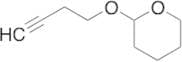
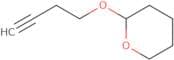
CAS 40365-61-5
:2-(3-butinyloxy)tetrahydro-2H-pyran
- 2H-Pyran, 2-(3-butynyloxy)tetrahydro-
- 2-(but-3-yn-1-yloxy)tetrahydro-2H-pyran
2-(3-Butynyloxy)Tetrahydro-2 H-Pyran
CAS:Formel:C9H14O2Reinheit:98%Farbe und Form:LiquidMolekulargewicht:154.20632-[(But-3-yn-1-yl)oxy]tetrahydro-2H-pyran
CAS:2-[(But-3-yn-1-yl)oxy]tetrahydro-2H-pyranFormel:C9H14O2Reinheit:97%Farbe und Form: clear. colourless liquidMolekulargewicht:154.21g/mol2-(3-Butynyloxy)tetrahydro-2H-pyran
CAS:Kontrolliertes ProduktApplications 2-(3-Butynyloxy)tetrahydro-2H-pyran is used as a reagent in the synthesis of Phomoidride D, a bridged, polycyclic, natural compound that has the ability to inhibit squalene synthase and can be used as an antihypercholesterolemic agent. 2-(3-Butynyloxy)tetrahydro-2H-pyran is also used as a reagent to prepare Rugulactone, a natural compound that is isolated from Cryptocarya rugulosa.
References Allais, F., et al.: Synthesis, 2010, 2787 (2010); Biller, S., et al.: Curr. Pharm. Des., 2, 1 (1996); Chen, C., et al.: J. Am. Chem. Soc., 122, 7424 (2000); Murphy, G., et al.: J. Org. Chem., 78, 477 (2013)Formel:C9H14O2Farbe und Form:NeatMolekulargewicht:154.212-(3-Butynyloxy)tetrahydro-2H-pyran
CAS:2-(3-Butynyloxy)tetrahydro-2H-pyran (BOP) is a synthetic chemical that interacts with the insect nervous system. It is an attractant for Lepidoptera and can be used to control pest populations. BOP has been shown to modify the behavior of conspecific insects, and it has also been shown to interact with other insecticides. BOP is a model study compound with stereospecificity, which means that it interacts differently when bound to lepidopteran or dipteran receptors. This compound has been found to have no effect on the metabolism of deoxyribose, but it does show some solvatochromism in different solvents.
Formel:C9H14O2Reinheit:Min. 95%Molekulargewicht:154.21 g/mol
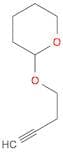

![2-[(But-3-yn-1-yl)oxy]tetrahydro-2H-pyran](/_next/image/?url=https%3A%2Fstatic.cymitquimica.com%2Fproducts%2F54%2Fthumb%2FOR52129.jpg&w=3840&q=75)