CAS 40497-30-1
:2-Methyl-4,6-pyrimidindion
Beschreibung:
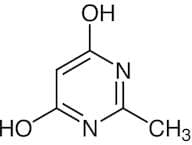
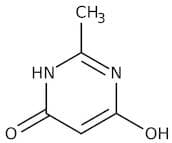
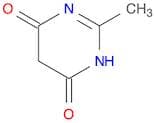
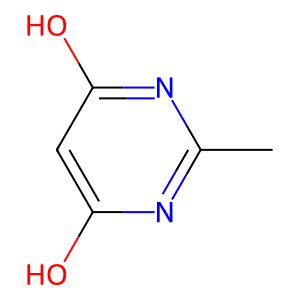
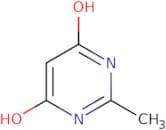
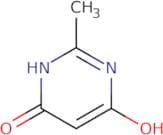
2-Methyl-4,6-pyrimidindion, auch bekannt als 2-Methyl-4,6-Dioxypyrimidin, ist eine organische Verbindung, die durch ihre Pyrimidinringstruktur gekennzeichnet ist, die zwei Carbonylgruppen (C=O) an den Positionen 4 und 6 und eine Methylgruppe an der Position 2 aufweist. Diese Verbindung ist typischerweise ein weißer bis schmutzig-weißer kristalliner Feststoff und ist in polaren Lösungsmitteln wie Wasser und Alkoholen löslich, was auf ihre Fähigkeit zurückzuführen ist, Wasserstoffbrücken zu bilden. Sie zeigt Tautomerie, bei der sie in verschiedenen Formen existieren kann, aufgrund der Verlagerung von Wasserstoffatomen und Doppelbindungen. Die Anwesenheit der Carbonylgruppen trägt zu ihrer Reaktivität bei, was sie zu einem potenziellen Zwischenprodukt in verschiedenen organischen Synthesereaktionen macht, insbesondere in der pharmazeutischen und agrochemischen Industrie. Darüber hinaus kann 2-Methyl-4,6-pyrimidindion biologische Aktivität zeigen, die für potenzielle Anwendungen in der medizinischen Chemie erforscht werden kann. Wie bei vielen chemischen Substanzen sollten beim Umgang mit ihr die entsprechenden Sicherheitsvorkehrungen beachtet werden, da sie potenziell toxisch und reaktiv ist.
Formel:C5H6N2O2
InChl:InChI=1S/C5H6N2O2/c1-3-6-4(8)2-5(9)7-3/h2H2,1H3,(H,6,7,8,9)
InChI Key:InChIKey=GNVCKXIBBIIFPE-UHFFFAOYSA-N
SMILES:O=C1CC(=O)N=C(C)N1
Synonyme:- 2-Methyl-1H-pyrimidine-4,6-dione
- 2-Methyl-4,6(1H,5H)-pyrimidinedione
- 2-Methylpyrimidin-4,6(3H,5H)-dione
- 2-methyl-1H,5H-pyrimidine-4,5-dione
- 2-methylpyrimidine-4,6(1H,5H)-dione
- 4(1H)-Pyrimidinone,6-hydroxy-2-methyl-
- 4,6(1H,5H)-Pyrimidinedione, 2-methyl-
- 4,6(1H,5H)-Pyrimidinedione, 2-methyl- (9CI)
- 6-Hydroxy-2-methylpyrimidin-4(3H)-one
- 2-Methyl-4,6-pyrimidinedione
- 2-Methyl-4,6-dichloropyrimidine
Sortieren nach
Reinheit (%)
0
100
|
0
|
50
|
90
|
95
|
100
8 Produkte.
4,6-Dihydroxy-2-methylpyrimidine
CAS:Formel:C5H6N2O2Reinheit:>96.0%(T)Farbe und Form:White to Light yellow to Light orange powder to crystalMolekulargewicht:126.124,6-Dihydroxy-2-methylpyrimidine, 99%
CAS:4,6-Dihydroxy-2-methylpyrimidine is used in the preparation of 4,6-dichloro-2-methyl-pyrimidine. This Thermo Scientific Chemicals brand product was originally part of the Alfa Aesar product portfolio. Some documentation and label information may refer to the legacy brand. The original Alfa Aesar prFormel:C5H6N2O2Reinheit:99%Farbe und Form:White to pale cream or pale pink, PowderMolekulargewicht:126.122-Methylpyrimidine-4,6(1H,5H)-dione
CAS:Formel:C5H6N2O2Reinheit:98%Farbe und Form:SolidMolekulargewicht:126.11334,6-Dihydroxy-2-methylpyrimidine
CAS:4,6-Dihydroxy-2-methylpyrimidineReinheit:98%Molekulargewicht:126.11g/mol4,6-Dihydroxy-2-methylpyrimidine
CAS:Formel:C5H6N2O2Reinheit:≥ 98.0%Farbe und Form:White to off-white crystalline powderMolekulargewicht:126.124,6-Dihydroxy-2-methylpyrimidine
CAS:4,6-Dihydroxy-2-methylpyrimidine is a versatile building block that can be used in the synthesis of a wide variety of chemical compounds. As a reagent, 4,6-dihydroxypyrimidine is used to synthesize many important chemicals, such as 5-aminoimidazole and 2,5-diaminopyrimidine. It is also a useful scaffold for the preparation of research chemicals and speciality chemicals. This compound has been described as high quality with an easy purification process. CAS No. 40497-30-1Formel:C5H6N2O2Molekulargewicht:126.12 g/molRef: 3D-D-3570
-Unit-kgkgNachfragen1kgNachfragen5kgNachfragen10kgNachfragen500gNachfragen2500gNachfragen4.6-Dihydroxy-2-methylpyrimidine
CAS:4,6-Dihydroxy-2-methylpyrimidine is a monomer that is used in the synthesis of polyurethanes. It is an intermediate in the reaction between hydrochloric acid and nitrous acid, which produces 4,6-dichloro-2-methylpyrimidine. The reaction mechanism involves transfer of a methyl group from an organic molecule to hydrochloric acid. This reaction can be carried out at either low or high pH values. The addition of magnesium salt increases the rate of the reaction by increasing the solubility of chloroformate in water. When ethyl esters are used as starting materials, a constant conversion rate can be obtained with a large excess of magnesium salt.Formel:C5H6N2O2Reinheit:Min 99%Farbe und Form:PowderMolekulargewicht:126.11 g/mol