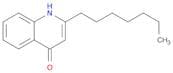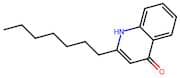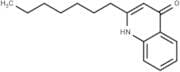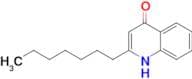
CAS 40522-46-1
:2-Heptyl-4-chinolon
Beschreibung:
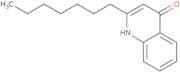
2-Heptyl-4-chinolon, mit der CAS-Nummer 40522-46-1, ist eine chemische Verbindung, die zur Klasse der Chinolone gehört, die bicyclische Verbindungen mit einer Chinolinstruktur sind. Diese Substanz zeichnet sich durch ihre heptylseitige Kette an der zweiten Position und eine Chinolon-Gruppe an der vierten Position aus. Sie zeigt typischerweise Eigenschaften wie eine blassgelbe bis bräunliche Flüssigkeit oder Feststoff, abhängig von ihrer Reinheit und spezifischen Bedingungen. 2-Heptyl-4-chinolon ist bekannt für seine biologische Aktivität, insbesondere im Kontext von Signalmolekülen in bestimmten Bakterienarten, wo es eine Rolle beim Quorum-Sensing spielen kann. Diese Verbindung kann auch antimikrobielle Eigenschaften aufweisen, was sie in verschiedenen Bereichen, einschließlich Mikrobiologie und Pharmazie, von Interesse macht. Ihre Löslichkeit kann variieren und ist oft in organischen Lösungsmitteln besser löslich als in Wasser. Wie viele Chinolon-Derivate kann sie auch eine Reihe chemischer Reaktivität zeigen, die in synthetischen Anwendungen oder weiteren chemischen Modifikationen genutzt werden kann.
Formel:C16H21NO
InChl:InChI=1S/C16H21NO/c1-2-3-4-5-6-9-13-12-16(18)14-10-7-8-11-15(14)17-13/h7-8,10-12H,2-6,9H2,1H3,(H,17,18)
InChI Key:InChIKey=UYRHHBXYXSYGHA-UHFFFAOYSA-N
SMILES:O=C1C=2C(NC(CCCCCCC)=C1)=CC=CC2
Synonyme:- Dihydroakutine
- 2-Heptyl-4(1H)-quinolinone
- Pseudane VII
- 4(1H)-Quinolinone, 2-heptyl-
- 4(1H)-Quinolone, 2-heptyl-
- 2-Heptyl-4-quinolone
- 2-Heptylquinoline-4(1H)-one
- 2-Heptylquinolin-4(1H)-one
- 2-heptyl-1H-quinolin-4-one
Sortieren nach
Reinheit (%)
0
100
|
0
|
50
|
90
|
95
|
100
5 Produkte.
4(1H)-Quinolinone, 2-heptyl-
CAS:Formel:C16H21NOReinheit:95%Farbe und Form:SolidMolekulargewicht:243.3440HHQ
CAS:HHQ (2-heptylquinolin-4(1H)-one) is a PqsR antagonist.Formel:C16H21NOReinheit:99.46%Farbe und Form:SolidMolekulargewicht:243.34Ref: TM-T19713
1mg47,00€2mgNachfragen5mg88,00€10mg143,00€25mg233,00€50mg344,00€100mg512,00€1mL*10mM (DMSO)96,00€2-Heptylquinolin-4(1H)-one
CAS:Pseudomonas aeruginosa is a Gram-negative bacterium that has been implicated in many infectious diseases. It is a multidrug resistant organism and can be difficult to treat. The mode of action of 2-heptylquinolin-4(1H)-one (2HQ) is not well understood, but it appears to inhibit the growth of P. aeruginosa by binding to copper ions. 2HQ was shown to exhibit antibacterial activity against wild-type strains of P. aeruginosa as well as mutants with reduced copper resistance. 2HQ also reduces the virulence and biofilm formation of P. aeruginosa cells and inhibits the expression of genes involved in energy metabolism, signal transduction, and chlorogenic acid biosynthesis (an endpoint for quorum sensing).
Formel:C16H21NOReinheit:Min. 95%Molekulargewicht:243.35 g/mol