CAS 407581-83-3
:1,4-dichlor 6-Carboxytetramethylrhodamin
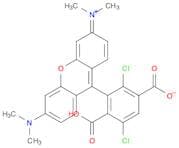
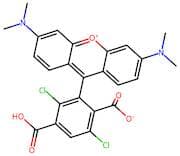
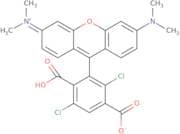
2-(3,6-Bis(dimethylamino)xanthylium-9-yl)-4-carboxy-3,6-dichlorobenzoate
CAS:Formel:C25H20Cl2N2O5Reinheit:95%Farbe und Form:SolidMolekulargewicht:499.34271,4-Dichloro 6-carboxytetramethylrhodamine
CAS:1,4-Dichloro 6-carboxytetramethylrhodamineReinheit:≥95%1,4-Dichloro 6-carboxytetramethylrhodamine
CAS:1,4-Dichloro 6-carboxytetramethylrhodamine is a rhodamine-class fluorescent dye with excitation/emission wavelengths of 541/568 nm.Formel:C25H20Cl2N2O5Reinheit:99.99%Farbe und Form:SolidMolekulargewicht:499.341,4-dichloro 6-Carboxytetramethylrhodamine
CAS:1,4-Dichloro 6-carboxytetramethylrhodamine (1,4-DCTMR) is a fluorescent dye that can be used to measure the activity of HIV reverse transcriptase. 1,4-DCTMR binds tightly to some residues in the enzyme's active site and fluoresces when it is irradiated with light at the wavelength of 490 nm. It has been shown that HIV mutants are resistant to zidovudine treatment. When a population of HIV mutants is exposed to zidovudine, there will be an increase in the number of mutant viruses that are resistant to zidovudine. The use of 1,4-DCTMR can be used as a marker for these resistant viruses and can help determine which mutations have occurred. 1,4-DCTMR is also used in research to study transcription polymerase chain reaction sequences and mutant populations.
Formel:C25H20Cl2N2O5Reinheit:Min. 95%Molekulargewicht:499.34 g/mol