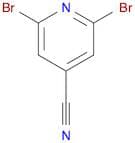
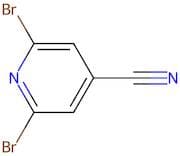
CAS 408352-58-9
:4-Pyridincarbonitril, 2,6-dibromo-
- 2,6-Dibromo-4-cyanopyridine
2,6-Dibromo-4-cyanopyridine
CAS:Formel:C6H2Br2N2Reinheit:95%Farbe und Form:SolidMolekulargewicht:261.90152,6-Dibromoisonicotinonitrile
CAS:2,6-DibromoisonicotinonitrileReinheit:95%Molekulargewicht:261.904g/mol2,6-Dibromoisonicotinonitrile
CAS:Formel:C6H2Br2N2Reinheit:95%Farbe und Form:SolidMolekulargewicht:261.9042,6-dibromopyridine-4-carbonitrile
CAS:2,6-Dibromopyridine-4-carbonitrile (2,6-DBPC) is a chemical compound with two bromine atoms and one carbon atom on each of the two pyridine rings. The bromine atoms are often used to form a probe for hydrostatic pressure and as a ligand in organic chemistry. 2,6-DBPC is also used as a luminescent material, which can be used to measure the hydrostatic pressure that is exerted on it. This chemical has been found to have excellent photophysical properties such as high quantum yield and good responsiveness. It also has excellent luminescence properties, such as high emission efficiency and long lifetime. The molecular structure of 2,6-DBPC is similar to that of other compounds with lanthanide ions in their structures. These include terbium(III) tris(2,6-dibromopyridine)chloride (Tb3+), euro
Formel:C6H2Br2N2Reinheit:Min. 95%Molekulargewicht:261.9 g/mol