CAS 4084-27-9
:3-Desoxyglucoson
Beschreibung:
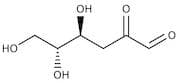
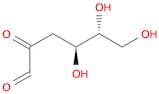
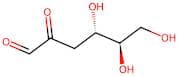
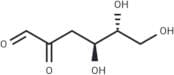
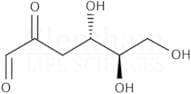
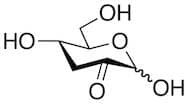
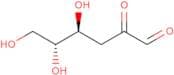
3-Desoxyglucoson (3-DG) ist eine reaktive Dicarbonylverbindung, die aus dem Glukosestoffwechsel abgeleitet ist. Sie zeichnet sich durch ihre Struktur aus, die eine Ketogruppe und eine Aldehydgruppe aufweist, was sie zu einem potenten Vorläufer bei der Bildung von fortgeschrittenen Glykationsendprodukten (AGEs) macht. Diese AGEs sind an verschiedenen pathologischen Zuständen beteiligt, einschließlich Diabetes und Herz-Kreislauf-Erkrankungen. 3-DG ist bekannt für seine Fähigkeit, mit Aminosäuren, Proteinen und Nukleinsäuren zu reagieren, was zu Modifikationen führen kann, die die Zellfunktion beeinflussen und zum oxidativen Stress beitragen können. Die Verbindung ist typischerweise in Spuren in biologischen Systemen vorhanden und kann durch nicht-enzymatische Glykationsprozesse gebildet werden. Ihre Reaktivität und potenziellen biologischen Effekte machen sie zu einem interessanten Forschungsgegenstand im Zusammenhang mit Stoffwechselstörungen und Alterung. Darüber hinaus kann 3-Desoxyglucoson mit verschiedenen Techniken, einschließlich Chromatographie und Massenspektrometrie, analysiert werden, um ihre Rolle in Gesundheit und Krankheit zu untersuchen.
Formel:C6H10O5
InChl:InChI=1S/C6H10O5/c7-2-4(9)1-5(10)6(11)3-8/h2,5-6,8,10-11H,1,3H2/t5-,6+/m0/s1
InChI Key:InChIKey=ZGCHLOWZNKRZSN-NTSWFWBYSA-N
SMILES:[C@H](CC(C=O)=O)([C@@H](CO)O)O
Synonyme:- 2-keto-3-Deoxyglucose
- 3-Deoxy-<span class="text-smallcaps">D</span>-erythro-hexos-2-ulose
- 3-Deoxy-<span class="text-smallcaps">D</span>-erythro-hexosulose
- 3-Deoxy-<span class="text-smallcaps">D</span>-glucosone
- 3-Deoxyglucosone
- <span class="text-smallcaps">D</span>-erythro-Hexos-2-ulose, 3-deoxy-
- <span class="text-smallcaps">D</span>-erythro-Hexosulose, 3-deoxy-
- D-erythro-hexos-2-ulose, 3-deoxy-
- 3-Deoxy-D-erythro-hexosulose
- D-erythro-Hexosulose, 3-deoxy-
- 3-Deoxy-D-erythro-hexos-2-ulose
Sortieren nach
Reinheit (%)
0
100
|
0
|
50
|
90
|
95
|
100
10 Produkte.
3-Deoxy-D-glucosone, 95%
CAS:Frequently used as a reference for the analysis and detection of glucose degradation products and glycating agents. Also used for cross-linking studies as it readily reacts with protein amino groups. This Thermo Scientific Chemicals brand product was originally part of the Alfa Aesar product portfolFormel:C6H10O5Reinheit:95%Farbe und Form:Yellow, Powder or crystals or crystalline powderMolekulargewicht:162.143-Deoxy-D-glucosone
CAS:3-Deoxy-D-glucosoneFormel:C6H10O5Reinheit:>95%Farbe und Form: yellow amorphous solidMolekulargewicht:162.14g/mol3-Deoxy-D-erythro-hexos-2-ulose
CAS:3-Deoxy-D-erythro-hexos-2-uloseReinheit:≥95%Farbe und Form:Pale Yellow SolidMolekulargewicht:162.14g/mol3-Deoxyglucosone
CAS:3-Deoxyglucosone(3-Deoxy-D-glucosone) is synthesized by the intermediate pathway of the melad and polyol reactions.3-Deoxyglucosone reacts rapidly with proteinFormel:C6H10O5Reinheit:95%Farbe und Form:SolidMolekulargewicht:162.143-Deoxyglucosone
CAS:Formel:C6H10O5Reinheit:One spotFarbe und Form:Pale yellow to yellow powder or solidMolekulargewicht:162.143-Deoxyglucosone
CAS:Stability Hygroscopic, Light Sensitive, Temperature Sensitive
Applications An intermediate in the Maillard reaction of proteins with glucose, which is metabolised to 3-Deoxyfructose. An intermediate in the formation of pyrraline, which might contribute to a pathological effect, such as carcinogenesis.
References Kato, H. et al.: Agric. Biol. Chem., 51, 683 (1987), Hayase, F. et al.: J. Biol. Chem., 264, 3758 (1989), Kato, H. et al.: Biochimica et Biophysica Acta, 1035, 71 (1990)Formel:C6H10O5Farbe und Form:White To YellowMolekulargewicht:162.143-Deoxy-D-glucosone
CAS:3-Deoxy-D-glucosone is a compound that belongs to the group of monosaccharides and has a basic structure. It can be found in many types of biological samples, including blood. The x-ray diffraction data for 3-deoxy-D-glucosone shows an asymmetric unit of two molecules with a coordination geometry of 2.3. This compound is known to have high protein oxidation rates, which are caused by dna binding activity. 3-Deoxyglucosone has been shown to be involved in the pathogenic mechanism of many types of cancers.Formel:C6H10O5Reinheit:Min. 95%Farbe und Form:PowderMolekulargewicht:162.14 g/mol