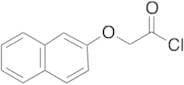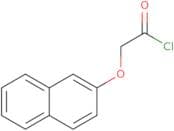
CAS 40926-77-0
:Acetylchlorid, (2-naphthalenyloxy)-
(2-Naphthyloxy)acetyl Chloride
CAS:Kontrolliertes ProduktApplications (2-Naphthyloxy)acetyl Chloride serves as one of the reagents for the discovery of indoline-2-carboxamide derivatives as new classs of brain-penetrant inhibitors of trypanosoma brucei. Also in preparation and antibacterial activity of N-(phenylquinazolinonyl) aryl-amides by amidation of amino(phenyl)quinazolone with aroyl chlorides
References Cleghorn, L. A., et al.: J. Med. Chem., 58, 7695 (2015); Prajapati, A. K., et al.: Indian J. Heterocycl. Chem., 19, 269 (2010)Formel:C12H9ClO2Farbe und Form:NeatMolekulargewicht:220.652(2-Naphthyloxy)acetyl chloride
CAS:(2-Naphthyloxy)acetyl chloride is an inhibitor of alcohol dehydrogenase, which is the enzyme that catalyzes the conversion of ethanol to acetaldehyde. It has been shown to be active against grapevine, but not against the yeast Saccharomyces cerevisiae. (2-Naphthyloxy)acetyl chloride inhibits alcohol dehydrogenase with a potency comparable to hexanol and ethylene glycol. It also inhibits esterases, which may account for its inhibitory effect on vinifera l. (2-Naphthyloxy)acetyl chloride has been shown to be more selective in inhibiting both alcohol and aldehyde dehydrogenases than hexanol or ethylene glycol.
Formel:C12H9ClO2Reinheit:Min. 95%Farbe und Form:Off-White PowderMolekulargewicht:220.65 g/molRef: 3D-FN121016
Ausgelaufenes produkt