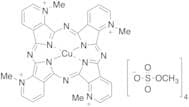
![Copper(4+), [1,8,15,22-tetramethyl-29H,31H-tetrapyrido[2,3-b:2′,3′-g:2′′,3′′-l:2′′′,3′′′-q]porphyr…](/_next/image/?url=https%3A%2Fstatic.cymitquimica.com%2Fcas-image%2Fthumb-webp%2F316460-copper-4-181522-tetramethyl-29h-31h-tetrapyrido-23-b-23-g-23-l-23-q-porphyraziniumato-2-kn29-kn30-kn31-kn32-sp-4-1-methyl-sulfate-1-4.webp&w=3840&q=75)
CAS 41276-95-3
:Kupfer(4+), [1,8,15,22-tetramethyl-29H,31H-tetrapyrido[2,3-b:2′,3′-g:2′′,3′′-l:2′′′,3′′′-q]porphyraziniumato(2-)-κN29,κN30,κN31,κN32]-, (SP-4-1)-, Methylsulfat (1:4)
Beschreibung:
Kupfer(4+), speziell im Kontext der von Ihnen erwähnten Verbindung, ist ein Koordinationskomplex, der Kupfer im Oxidationszustand +4 enthält, was im Vergleich zu seinen häufigeren Oxidationszuständen +1 und +2 relativ selten ist. Diese Verbindung zeichnet sich durch ihre komplexe Struktur aus, die ein Porphyrazin-Gerüst umfasst, eine Art makrozyklischer Liganden, die für ihre Fähigkeit bekannt ist, mit Metallionen zu koordinieren. Die Anwesenheit mehrerer Methylgruppen im Liganden erhöht dessen Löslichkeit und Stabilität. Die Methylsulfatkomponente deutet darauf hin, dass die Verbindung wahrscheinlich ein Salz ist, was ihre Löslichkeit und Reaktivität in verschiedenen Lösungsmitteln beeinflussen kann. Die Koordination des Kupferions mit Stickstoffatomen aus der Porphyrazinstruktur deutet auf potenzielle Anwendungen in der Katalyse oder als Farbstoff hin, angesichts der elektronischen Eigenschaften, die durch die Metall-Ligand-Interaktionen vermittelt werden. Insgesamt veranschaulicht diese Verbindung die Komplexität und Vielseitigkeit von metallorganischen Rahmen in der Koordinationschemie.
Formel:C32H24CuN12·4CH3O4S
InChl:InChI=1S/C32H24N12.CH4O4S.Cu/c1-41-13-5-9-17-21(41)29-33-25(17)38-30-23-19(11-7-15-43(23)3)27(35-30)40-32-24-20(12-8-16-44(24)4)28(36-32)39-31-22-18(26(34-31)37-29)10-6-14-42(22)2;1-5-6(2,3)4;/h5-16H,1-4H3;1H3,(H,2,3,4);/q+2;;+2/p-1
InChI Key:InChIKey=OHJXJJRFAPKPSP-UHFFFAOYSA-M
SMILES:C[N+]1=C2C=3[N-]4[Cu+2]56[N-]7C(=C8C(=C7N=C9[N]5=C(N3)C=%10C9=[N+](C)C=CC%10)C=CC=[N+]8C)N=C%11[N]6=C(N=C4C2=CC=C1)C=%12C%11=CC=C[N+]%12C.S(OC)(=O)(=O)[O-]
Synonyme:- Copper(4+), [1,8,15,22-tetramethyl-29H,31H-tetrapyrido[2,3-b:2′,3′-g:2′′,3′′-l:2′′′,3′′′-q]porphyraziniumato(2-)-κN29,κN30,κN31,κN32]-, (SP-4-1)-, tetrakis(methyl sulfate)
- Copper(4+), [1,8,15,22-tetramethyl-29H,31H-tetrapyrido[2,3-b:2′,3′-g:2′′,3′′-l:2′′′,3′′′-q]porphyraziniumato(2-)-N29,N30,N31,N32]-, (SP-4-1)-, tetrakis(methyl sulfate)
- 29H,31H-Tetrapyrido[2,3-b:2′,3′-g:2′′,3′′-l:2′′′,3′′′-q]porphyrazinium, 1,8,15,22-tetramethyl-, copper complex
- 29H,31H-Tetrapyrido[2,3-b:2′,3′-g:2′′,3′′-l:2′′′,3′′′-q]porphyrazine, copper(4+) deriv.
- (1,8,15,22-Tetramethyl-29H,31H-tetrapyrido(2,3-b:2',3'-g:2'',3''-l:2''',3'''-q)porphyraziniumato(2-)-N29,N30,N31,N32)copper(4+) tetramethyl tetrakis(sulphate)
- Copper(4+), [1,8,15,22-tetramethyl-29H,31H-tetrapyrido[2,3-b:2′,3′-g:2′′,3′′-l:2′′′,3′′′-q]porphyraziniumato(2-)-κN29,κN30,κN31,κN32]-, (SP-4-1)-, methyl sulfate (1:4)
Sortieren nach
Reinheit (%)
0
100
|
0
|
50
|
90
|
95
|
100
3 Produkte.
Cuprolinic Blue (>90%)
CAS:Kontrolliertes ProduktApplications Cuprolinic Blue, has been shown to be able to form a particularly stable blue chromophore with single-stranded RNA in neuronal Nissl substance and nucleoli, and thus can be used for counterstaining of enteric neurons for peroxidase immunocytochemistry
References Holst, M., et al.: J. Neurosci., Meth., 62, 121 (1995);Formel:C32H26N12·4CH3O4S·CuReinheit:>90%Farbe und Form:NeatMolekulargewicht:1086.56Cuprolinic Blue-d12
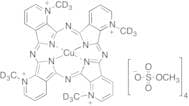
CAS:Kontrolliertes ProduktApplications Cuprolinic Blue-d12 is the labeled analogue of Cuprolinic Blue (C834800), which has been shown to be able to form a particularly stable blue chromophore with single-stranded RNA in neuronal Nissl substance and nucleoli, and thus can be used for counterstaining of enteric neurons for peroxidase immunocytochemistry.
References Holst, M., et al.: J. Neurosci., Meth., 62, 121 (1995)Formel:C35H12D12CuN12•4(CD3O4S)Farbe und Form:Dark BlueMolekulargewicht:1108.69Cuprolinic blue
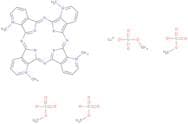
CAS:Cuprolinic blue is a fluorescent dye that is used for collagen gel localization and histochemical staining. It binds to the amide groups of proteins, such as collagen, and stains them blue. Cuprolinic blue has been used to show the ultrastructural localisation of collagen in blood capillaries in vivo. Cuprolinic blue also binds to nuclear DNA and can be used as a marker for the localization of nuclei in cells. This dye can also be used as an indicator for cervical cancer and proteoglycans in proteoglycan-enriched tissues.Formel:C36H36CuN12O16S4Reinheit:90%MinFarbe und Form:PowderMolekulargewicht:1,084.6 g/mol