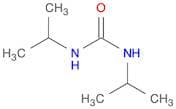
CAS 4128-37-4
:N,N'-Bis(1-methylethyl)harnstoff
- 1,3-Bis(propan-2-yl)urea
- 1,3-Di(propan-2-yl)urea
- 1,3-Dipropan-2-Ylurea
- Diptocarpamidine
- N,N'-Bis(isopropyl)urea
- N,N'-Diisopropylurea
- N,N′-Bis(1-methylethyl)urea
- Nsc 112719
- Urea, 1,3-diisopropyl-
- Urea, 1,3-diisopropyl- (8CI)
- Urea, N,N'-bis(1-methylethyl)-
- 1,3-Diisopropylurea
- 1,3-Diisopropylurea
- 3-diisopropylurea
- Bosutinib Impurity 23 (1,3-Diisopropylurea)
- Diquafosol Impurity-DIU
- Bosutinib Impurity 30
- Weitere Synonyme anzeigen
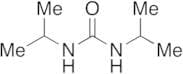
1,3-Bis(propan-2-yl)urea
CAS:1,3-Bis(propan-2-yl)ureaFormel:C7H16N2OReinheit:95%Farbe und Form: white solidMolekulargewicht:144.21g/molBosutinib Impurity 23
CAS:Formel:C7H16N2OFarbe und Form:White To Off-White SolidMolekulargewicht:144.221,3-Diisopropylurea
CAS:Formel:C7H16N2OReinheit:≥ 97.0%Farbe und Form:White to off-white powderMolekulargewicht:144.211,3-Diisopropylurea-d14
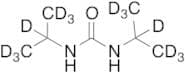
CAS:Kontrolliertes ProduktApplications 1,3-Diisopropylurea-d14 is the labeled analogue of 1,3-Diisopropylurea (D459850), one of the photocatalyzed degradation products of the herbicide Bromacil.
References Singh, H.K. et al.: Photochem. Photobiol. Sci., 2, 151 (2003)Formel:C7D14H2N2OFarbe und Form:NeatMolekulargewicht:158.3011,3-Diisopropylurea
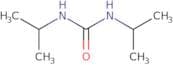
CAS:Kontrolliertes ProduktApplications 1,3-Diisopropylurea is one of the photocatalyzed degradation products of the herbicide Bromacil.
References Singh, H.K. et al.: Photochem. Photobiol. Sci., 2, 151 (2003);Formel:C7H16N2OFarbe und Form:NeatMolekulargewicht:144.211,3-Diisopropylurea
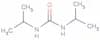
CAS:1,3-Diisopropylurea is a chemical substance that is used as a sample preparation reagent. It can be used to convert ethylmalonic acid into methyl anthranilate and methyl ethyl malonic acid. The chemical reactions that occur are not fully understood, but it is thought that they may be due to the formation of an enzyme-substrate complex. 1,3-Diisopropylurea has been shown to have potent anticancer properties in vitro and in vivo by inhibiting the synthesis of fatty acids and thus interfering with cell division. The biomimetic properties of this compound may be due to its ability to mimic the biological functions of malonic acid.
Formel:C7H16N2OReinheit:Min. 95 Area-%Farbe und Form:White PowderMolekulargewicht:144.21 g/molRef: 3D-FD22149
Ausgelaufenes produkt