CymitQuimica logo

CAS 41318-68-7

:

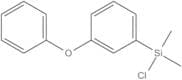
chloro-dimethyl-(3-phenoxyphenyl)silan

Beschreibung:
chloro-dimethyl-(3-phenoxyphenyl)silan, mit der CAS-Nummer 41318-68-7, ist eine organosiliciumverbindung, die durch das Vorhandensein eines Siliziumatoms gekennzeichnet ist, das an zwei Methylgruppen, eine chlorierte Gruppe und eine Phenoxyphenyl-Gruppe gebunden ist. Diese Verbindung weist typischerweise eine Silanstruktur auf, die zu ihrer Reaktivität und potenziellen Anwendungen in verschiedenen chemischen Prozessen beiträgt, einschließlich als Kopplungsagent oder in der Synthese komplexerer Silan-Derivate. Das Vorhandensein der chlorierten Gruppe erhöht ihre Reaktivität, was eine weitere Funktionalisierung oder Vernetzung in der Polymerchemie ermöglicht. Die Phenoxyphenyl-Gruppe kann spezifische Eigenschaften wie erhöhte Hydrophobizität oder verbesserte thermische Stabilität verleihen, was sie für Anwendungen in Beschichtungen, Klebstoffen oder als Modifikator in silikonbasierten Materialien geeignet macht. Darüber hinaus kann die einzigartige Struktur der Verbindung ihre Löslichkeit und Wechselwirkung mit anderen chemischen Spezies beeinflussen, was für ihre praktischen Anwendungen in industriellen und Forschungsumgebungen wichtig ist. Sicherheitsvorkehrungen sollten beim Umgang mit dieser Verbindung aufgrund ihrer reaktiven Natur beachtet werden.
Formel:C14H15ClOSi
InChl:InChI=1/C14H15ClOSi/c1-17(2,15)14-10-6-9-13(11-14)16-12-7-4-3-5-8-12/h3-11H,1-2H3
SMILES:C[Si](C)(c1cccc(c1)Oc1ccccc1)Cl
Synonyme:
  • Benzene, 1-(chlorodimethylsilyl)-3-phenoxy-
  • Chloro(dimethyl)(3-phenoxyphenyl)silane
Sortieren nach

Reinheit (%)
0
100
|
0
|
50
|
90
|
95
|
100
1 Produkte.
  • 3-PHENOXYPHENYLDIMETHYLCHLOROSILANE, 92%

    CAS:
    <p>Aromatic Silane - Conventional Surface Bonding<br>Aliphatic, fluorinated aliphatic or substituted aromatic hydrocarbon substituents are the hydrophobic entities which enable silanes to induce surface hydrophobicity. The organic substitution of the silane must be non-polar. The hydrophobic effect of the organic substitution can be related to the free energy of transfer of hydrocarbon molecules from an aqueous phase to a homogeneous hydrocarbon phase. A successful hydrophobic coating must eliminate or mitigate hydrogen bonding and shield polar surfaces from interaction with water by creating a non-polar interphase. Although silane and silicone derived coatings are in general the most hydrophobic, they maintain a high degree of permeability to water vapor. This allows coatings to breathe and reduce deterioration at the coating interface associated with entrapped water. Since ions are not transported through non-polar silane and silicone coatings, they offer protection to composite structures ranging from pigmented coatings to rebar reinforced concrete. A selection guide for hydrophobic silanes can be found on pages 22-31 of the Hydrophobicity, Hydrophilicity and Silane Surface Modification brochure.<br>3-Phenoxyphenyldimethylchlorosilane; Dimethyl m-phenoxyphenylchlorosilane<br>Contains other isomersEnd-capper for low-temperature lubricating fluids<br></p>
    Formel:C14H15ClOSi
    Reinheit:92%
    Farbe und Form:Straw Liquid
    Molekulargewicht:262.81

    Ref: 3H-SIP6723.0

    5g
    Nachfragen