CAS 41513-04-6
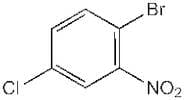
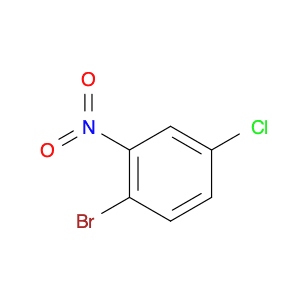
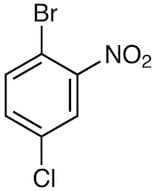
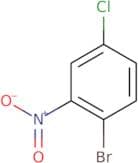
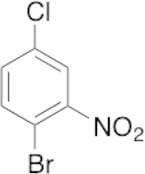
:1-Brom-4-chlor-2-nitrobenzol
Beschreibung:
1-Brom-4-chlor-2-nitrobenzol ist eine aromatische Verbindung, die durch das Vorhandensein eines Bromatoms, eines Chloratoms und einer Nitrogruppe, die an einen Benzolring gebunden ist, gekennzeichnet ist. Ihre molekulare Formel ist C6H3BrClN2O2, was darauf hinweist, dass sie sechs Kohlenstoffatome, drei Wasserstoffatome, ein Bromatom, ein Chloratom, zwei Stickstoffatome und zwei Sauerstoffatome enthält. Diese Verbindung erscheint typischerweise als gelb-brauner Feststoff und ist bekannt für ihre mäßige Löslichkeit in organischen Lösungsmitteln. Sie zeigt Eigenschaften, die typisch für halogenierte Nitrobenzene sind, einschließlich potenzieller Anwendungen in der organischen Synthese und als Zwischenprodukt in der Herstellung von Farbstoffen, Arzneimitteln und Agrochemikalien. Das Vorhandensein sowohl halogenierter als auch nitrofunktioneller Gruppen trägt zu ihrer Reaktivität bei, was sie zu einem nützlichen Baustein in verschiedenen chemischen Reaktionen macht. Es ist jedoch wichtig, diese Verbindung mit Vorsicht zu behandeln, da sie potenziell toxisch ist und Auswirkungen auf die Umwelt hat, sowie geeignete Sicherheitsprotokolle zu befolgen, wenn man in einem Labor mit ihr arbeitet.
Formel:C6H3BrClNO2
InChl:InChI=1/C6H3BrClNO2/c7-5-2-1-4(8)3-6(5)9(10)11/h1-3H
InChI Key:InChIKey=UKTIMFAJRPSNGR-UHFFFAOYSA-N
SMILES:N(=O)(=O)C1=C(Br)C=CC(Cl)=C1
Synonyme:- 1-Bromo-2-nitro-4-chlorobenzene
- 2-Bromo-5-chloronitrobenzene
- 4-Bromo-3-nitrochlorobenzene
- 4-Chloro-2-bromonitrobenzene
- Benzene, 1-bromo-4-chloro-2-nitro-
- 1-Bromo-4-chloro-2-nitrobenzene
- 2-Nitro-4-chlorophenyl bromide
- 3-Nitro-4-bromophenyl chloride
Sortieren nach
Reinheit (%)
0
100
|
0
|
50
|
90
|
95
|
100
8 Produkte.
1-Bromo-4-chloro-2-nitrobenzene, 98%
CAS:This Thermo Scientific Chemicals brand product was originally part of the Alfa Aesar product portfolio. Some documentation and label information may refer to the legacy brand. The original Alfa Aesar product / item code or SKU reference has not changed as a part of the brand transition to Thermo SciFormel:C6H3BrClNO2Reinheit:98%Farbe und Form:Pale cream to cream to yellow to brown, Crystals or powder or crystalline powderMolekulargewicht:236.451-Bromo-4-chloro-2-nitrobenzene
CAS:Formel:C6H3BrClNO2Reinheit:97%Farbe und Form:SolidMolekulargewicht:236.45052-Bromo-5-chloronitrobenzene
CAS:2-Bromo-5-chloronitrobenzeneFormel:C6H3BrClNO2Reinheit:≥95%Farbe und Form: greenish tan crystalsMolekulargewicht:236.45g/mol1-Bromo-4-chloro-2-nitrobenzene
CAS:Formel:C6H3BrClNO2Reinheit:>98.0%(GC)Farbe und Form:White to Light yellow powder to crystalMolekulargewicht:236.452-Bromo-5-chloronitrobenzene
CAS:2-Bromo-5-chloronitrobenzene is a synthetic drug that has been shown to inhibit the growth of cancer cells. It is a potent antagonist at the tyrosine kinase receptor, which may be involved in the development of some cancers. The drug was first synthesized in 1887 by German chemists for use as an antipsychotic drug, but it was not until 1962 that researchers discovered its therapeutic value in treating schizophrenia. Clozapine also blocks the activity of other receptors including factor receptors and growth factors, which may account for its antitumor effects. Clozapine has also been used to treat resistant breast cancer cases with imatinib therapy.Formel:C6H3BrClNO2Reinheit:Min. 95%Farbe und Form:PowderMolekulargewicht:236.45 g/mol2-Bromo-5-chloronitrobenzene
CAS:Formel:C6H3BrClNO2Reinheit:95%Farbe und Form:SolidMolekulargewicht:236.451-Bromo-4-chloro-2-nitrobenzene
CAS:Kontrolliertes ProduktApplications 1-Bromo-4-chloro-2-nitrobenzene is used in the synthesis of diindolocarbazoles used in the synthesis of ladder oligo(p-aniline)s useful in organic electronics. Also used in the synthesis of novel benzenesulfonamides for the discovery of potent cell cycle inhibitors.
References Wakim, S. et al.: Org. Lett., 6, 3413 (2004); Owa, T. et al.: Bioorg. Med. Chem. Lett., 10, 1223 (2000);Formel:C6H3BrClNO2Farbe und Form:NeatMolekulargewicht:236.45