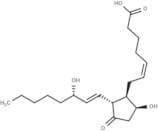
CAS 41598-07-6
:PGD2
Beschreibung:
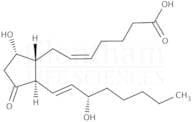
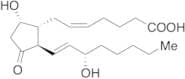
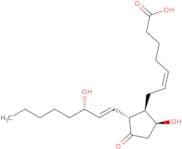
Prostaglandin D2 (PGD2) ist eine natürlich vorkommende Prostaglandin, die eine bedeutende Rolle in verschiedenen physiologischen Prozessen spielt, einschließlich Entzündungen und Schlafregulation. Sie wird aus Arachidonsäure durch die Wirkung von Cyclooxygenase-Enzymen synthetisiert. PGD2 zeichnet sich durch ihre Fähigkeit aus, als Signalmolekül zu wirken, indem sie an spezifische Rezeptoren wie DP1 und DP2 bindet, die an der Vermittlung ihrer Wirkungen auf die Entspannung der glatten Muskulatur, die Hemmung der Thrombozytenaggregation und die Modulation der Immunantworten beteiligt sind. Diese Verbindung ist auch an allergischen Reaktionen beteiligt und wurde hinsichtlich ihrer Rolle bei Erkrankungen wie Asthma und Schlafstörungen untersucht. In Bezug auf ihre chemische Struktur weist PGD2 einen Cyclopentanring und mehrere funktionelle Gruppen auf, die zu ihrer biologischen Aktivität beitragen. Als lipider Mediator ist PGD2 typischerweise in niedrigen Konzentrationen in Geweben vorhanden und wird schnell metabolisiert, was ihre transiente Natur in biologischen Systemen unterstreicht. Ihre CAS-Nummer, 41598-07-6, ist eine eindeutige Kennung, die für regulatorische und Forschungszwecke verwendet wird.
Formel:C20H32O5
InChl:InChI=1S/C20H32O5/c1-2-3-6-9-15(21)12-13-17-16(18(22)14-19(17)23)10-7-4-5-8-11-20(24)25/h4,7,12-13,15-18,21-22H,2-3,5-6,8-11,14H2,1H3,(H,24,25)/b7-4-,13-12+/t15-,16+,17+,18-/m0/s1
InChI Key:InChIKey=BHMBVRSPMRCCGG-OUTUXVNYSA-N
SMILES:C(/C=C\CCCC(O)=O)[C@@H]1[C@@H](/C=C/[C@H](CCCCC)O)C(=O)C[C@@H]1O
Synonyme:- (5Z,9alpha,13E,15S)-9,15-dihydroxy-11-oxoprosta-5,13-dien-1-oic acid
- (5Z,9α,13E,15S)-9,15-Dihydroxy-11-oxoprosta-5,13-dien-1-oic acid
- 11-Dehydroprostaglandin F<sub>2α</sub>
- PGD<sub>2</sub>
- Prosta-5,13-dien-1-oic acid, 9,15-dihydroxy-11-oxo-, (5Z,9α,13E,15S)-
- Prostaglandin D2
- Prostaglandin D<sub>2</sub>
- prostaglandin D2 cell culture tested
- 11-Dehydroprostaglandin F2α
- PGD2
Sortieren nach
Reinheit (%)
0
100
|
0
|
50
|
90
|
95
|
100
6 Produkte.
Prostaglandin D2 MaxSpec® Standard
CAS:Formel:C20H32O5Reinheit:99%Farbe und Form:SolidMolekulargewicht:352.4651Prostaglandin D2
CAS:Formel:C20H32O5Reinheit:≥ 98.0%Farbe und Form:White to light yellow solidMolekulargewicht:352.47Prostaglandin D2
CAS:Kontrolliertes ProduktStability Light Sensitive
Applications Prostaglandin D2 is a fatty acid compound present in the human body. Elevated levels of localized Prostaglandin D2 has been linked to hair loss and growth inhibition. It has also been seen to contribute to the activity of allergic asthma.
References Matsuoka, T. et al.: Science., 287, 2013 (2000); Luis, G. et al.: Sci. Transl., 4, 126 (2012);Formel:C20H32O5Farbe und Form:NeatMolekulargewicht:352.47Prostaglandin D2
CAS:Prostaglandin D2 is a lipid mediator and a member of the prostaglandin family. It is produced in many tissues, including the brain, lungs, heart, kidneys, and intestines. Prostaglandin D2 has been shown to be an intracellular target for nonsteroidal anti-inflammatory drugs (NSAIDs) such as ibuprofen. NSAIDs inhibit cyclooxygenase 1 and 2 (COX-1 and COX-2) enzymes that produce prostaglandins from arachidonic acid. This inhibition leads to decreased production of prostaglandin D2 in the brain and other organs. Prostaglandin D2 has been shown to have cardiac effects by acting on receptors present in the heart cells. The response element for prostaglandin D2 is found upstream of several genes that control bowel function, including cytosolic Ca2+, polymorphonuclear leucocytes, and tight junction proteins.Formel:C20H32O5Reinheit:Area-% Min. 95 Area-%Molekulargewicht:352.47 g/molProstaglandin D2
CAS:Prostaglandin D2 (PGD2) is one of the major PGs actively produced in the brain of various mammals,and is a potent endogenous sleep promoting substances.
Formel:C20H32O5Reinheit:>99.99%Farbe und Form:SolidMolekulargewicht:352.47