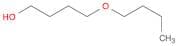
CAS 4161-24-4
:4-Butoxybutan-1-ol
Beschreibung:
4-Butoxybutan-1-ol, mit der CAS-Nummer 4161-24-4, ist eine organische Verbindung, die als Butanol-Derivat klassifiziert ist. Es weist eine Butoxy-Gruppe auf, die an ein Butan-1-ol-Rückgrat gebunden ist, was es zu einem Mitglied der funktionellen Gruppe der Alkohole macht. Diese Verbindung ist typischerweise eine farblose bis blassgelbe Flüssigkeit mit einem charakteristischen Geruch. Sie ist in Wasser und organischen Lösungsmitteln löslich, was ihre Nützlichkeit in verschiedenen Anwendungen erhöht, einschließlich als Lösungsmittel und in der chemischen Synthese. Die Anwesenheit sowohl hydrophober (Butoxy-) als auch hydrophiler (Alkohol-) Komponenten in ihrer Struktur trägt zu ihrer amphiphilen Natur bei, die es ihr ermöglicht, mit sowohl polaren als auch unpolaren Substanzen zu interagieren. 4-Butoxybutan-1-ol wird in Formulierungen für Beschichtungen, Klebstoffe und Reinigungsprodukte verwendet, da es die Eigenschaften dieser Materialien verbessert. Sicherheitsdaten zeigen, dass, wie bei vielen Alkoholen, Vorsicht geboten ist, da es bei Kontakt mit Haut oder Augen Reizungen verursachen kann und in gut belüfteten Bereichen verwendet werden sollte, um das Einatmen von Dämpfen zu vermeiden.
Formel:C8H18O2
InChl:InChI=1/C8H18O2/c1-2-3-7-10-8-5-4-6-9/h9H,2-8H2,1H3
SMILES:CCCCOCCCCO
Synonyme:- 1-Butanol, 4-Butoxy-
Sortieren nach
Reinheit (%)
0
100
|
0
|
50
|
90
|
95
|
100
5 Produkte.
4-Butoxy-1-butanol
CAS:Kontrolliertes Produkt4-Butoxy-1-butanol is a solvent that has been shown to be safe for use in humans. It is used to modify the chemical structure of d-glycero-d-galacto-heptose and can be used as a solvent. 4-Butoxy-1-butanol was found to be safe for primary cells and was able to normalize their metabolism and growth rate. This compound has also been shown to have diagnostic properties based on its ability to inhibit the production of camaldulensis leaves, which are known to produce naphthalene. The mechanism by which this compound inhibits camaldulensis leaf production is unknown, but it may involve an acceptor molecule or biochemical reactions.Formel:C8H18O2Reinheit:Min. 95%Farbe und Form:Clear LiquidMolekulargewicht:146.23 g/mol4-Butoxybutanol
CAS:Kontrolliertes ProduktApplications 4-Butoxybutanol is used in the synthesis of biomedical polyurethane for application as scaffold materials.
References Liu, H. et al.: J. App. Polym. Sci., 117, 235 (2010);Formel:C8H18O2Farbe und Form:NeatMolekulargewicht:146.23