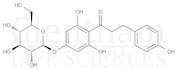
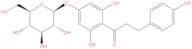
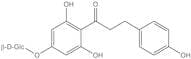
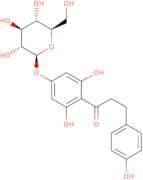
CAS 4192-90-9
:Trilobatin
Beschreibung:
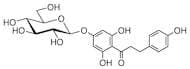
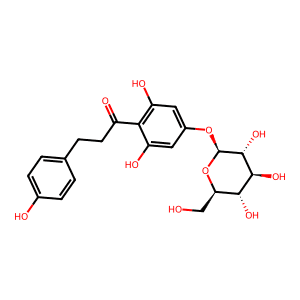
Trilobatin, mit der CAS-Nummer 4192-90-9, ist eine chemische Verbindung, die zur Klasse der Flavonoide gehört, spezifisch zu einem Flavonol-Glykosid. Es wird hauptsächlich aus verschiedenen pflanzlichen Quellen gewonnen, insbesondere aus solchen der Familie der Hülsenfrüchte. Trilobatin zeichnet sich durch seine glykosidische Struktur aus, die aus einem Flavonoid-Aglykon besteht, das an eine Zuckereinheit gebunden ist. Diese Verbindung zeigt eine Reihe biologischer Aktivitäten, einschließlich antioxidativer Eigenschaften, die zu ihren potenziellen gesundheitlichen Vorteilen beitragen. Darüber hinaus wurde Trilobatin auf seine entzündungshemmenden und antimikrobiellen Wirkungen untersucht. Seine Löslichkeitseigenschaften können je nach verwendetem Lösungsmittel variieren, und es ist in der Regel in polaren Lösungsmitteln aufgrund der Anwesenheit des Zuckers besser löslich. Wie viele Flavonoide kann Trilobatin auch eine Rolle bei der Pflanzenpigmentierung und dem UV-Schutz spielen. Weitere Forschungen sind im Gange, um seine Wirkmechanismen und potenziellen Anwendungen in der Pharmazie und Nutraceuticals vollständig zu klären.
Formel:C21H24O10
InChl:InChI=1/C21H24O10/c22-9-16-18(27)19(28)20(29)21(31-16)30-12-7-14(25)17(15(26)8-12)13(24)6-3-10-1-4-11(23)5-2-10/h1-2,4-5,7-8,16,18-23,25-29H,3,6,9H2/t16-,18-,19+,20-,21-/m1/s1
InChI Key:InChIKey=GSTCPEBQYSOEHV-QNDFHXLGSA-N
SMILES:C(CCC1=CC=C(O)C=C1)(=O)C2=C(O)C=C(O[C@@H]3O[C@H](CO)[C@@H](O)[C@H](O)[C@H]3O)C=C2O
Synonyme:- 1-Propanone, 1-(4-(beta-D-glucopyranosyloxy)-2,6-dihydroxyphenyl)-3-(4-hydroxyphenyl)-
- 1-Propanone, 1-[4-(β-<span class="text-smallcaps">D</span>-glucopyranosyloxy)-2,6-dihydroxyphenyl]-3-(4-hydroxyphenyl)-
- 1-[4-(β-<span class="text-smallcaps">D</span>-Glucopyranosyloxy)-2,6-dihydroxyphenyl]-3-(4-hydroxyphenyl)-1-propanone
- Phloretin 4′-glucoside
- Phloretin 4′-β-<span class="text-smallcaps">D</span>-glucoside
- Phloretin-4′-O-β-<span class="text-smallcaps">D</span>-glucopyranoside
- Phloretine-4′-glucoside
- Prunin dihydrochalcone
- Trilobatin
- p-Phloridzin
- p-Phlorizin
- 1-[4-(β-D-Glucopyranosyloxy)-2,6-dihydroxyphenyl]-3-(4-hydroxyphenyl)-1-propanone
- 1-Propanone, 1-[4-(β-D-glucopyranosyloxy)-2,6-dihydroxyphenyl]-3-(4-hydroxyphenyl)-
- TRILOBATIN(SH)
- PRUNINDIHYDROCHALCONE
- 1-[2,6-dihydroxy-4-[(2S,3R,4S,5S,6R)-3,4,5-trihydroxy-6-(hydroxymethyl)oxan-2-yl]oxyphenyl]-3-(4-hydroxyphenyl)propan-1-one
- Weitere Synonyme anzeigen
Sortieren nach
Reinheit (%)
0
100
|
0
|
50
|
90
|
95
|
100
9 Produkte.
Trilobatin
CAS:Formel:C21H24O10Reinheit:>95.0%(T)(HPLC)Farbe und Form:White to Light yellow powder to crystalMolekulargewicht:436.41Trilobatin
CAS:Trilobatin analytical standard provided with w/w absolute assay, to be used for quantitative titration.Formel:C21H24O10Reinheit:(HPLC) ≥99%Farbe und Form:PowderMolekulargewicht:436.42Trilobatin
CAS:Trilobatin has anti-oxidant, and anti-inflammatory effects, it can increase superoxide dismutase (SOD) activity, and it potentially inhibits the lipopolysaccharide (LPS)-induced inflammatory response by suppressing the NF-κB signaling pathway. Trilobatin shows a strong inhibitory activity against α-glucosidase and a moderate inhibitory activity against α-amylase for management of postprandial hyperglycemia with less side effect.Formel:C21H24O10Reinheit:95%~99%Farbe und Form:PowderMolekulargewicht:436.413Trilobatin
CAS:Trilobatin (P-Phlorizin) has anti-oxidant effect, can increase superoxide dismutase (SOD) activity.Trilobatin has anti-inflammatory effect, it potentiallyFormel:C21H24O10Reinheit:97.16%Farbe und Form:SolidMolekulargewicht:436.41Ref: TM-T2S0731
1mg50,00€5mg99,00€1mL*10mM (DMSO)109,00€10mg141,00€25mg260,00€50mg385,00€100mg557,00€200mg790,00€Trilobatin
CAS:Trilobatin is a high-purity steviol glycoside that is extracted from the leaves of the plant Stevia rebaudiana. It has been shown to have significant antioxidant properties, and its use as an anti-inflammatory agent has been shown in animal models. Trilobatin inhibits oxidative injury by binding to toll-like receptors on the surface of cells, preventing activation of certain enzymes and reducing inflammation. This activity may be due to inhibition of caspase-independent cell death or mitochondrial membrane potential. Trilobatin also acts as a pro-apoptotic protein by triggering the release of cytochrome C from mitochondria, which leads to apoptosis.Formel:C21H24O10Reinheit:Min. 95%Farbe und Form:PowderMolekulargewicht:436.41 g/mol