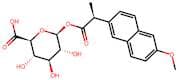
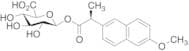
![1-O-[(2S)-2-(6-methoxynaphthalen-2-yl)propanoyl]-beta-D-glucopyranuronic acid](/_next/image/?url=https%3A%2Fstatic.cymitquimica.com%2Fcas-image%2Fthumb-webp%2F41341-1-o-2s-2-6-methoxynaphthalen-2-yl-propanoyl-beta-d-glucopyranuronic-acid.webp&w=3840&q=75)
CAS 41945-43-1
:1-O-[(2S)-2-(6-methoxynaphthalin-2-yl)propanoyl]-beta-D-glucopyranuronsäure
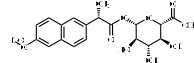
Naproxen-acyl-β-D-glucuronide
CAS:Naproxen-acyl-β-D-glucuronideFormel:H2Reinheit:>98%Farbe und Form: white amorphous solidMolekulargewicht:406.38g/molNaproxen Acyl Glucuronide
CAS:Formel:C20H22O9Farbe und Form:White To Off-White SolidMolekulargewicht:406.39Naproxen Impurity 1 Sodium Salt
CAS:Formel:C18H21O4·NaFarbe und Form:Yellow SolidMolekulargewicht:301.36 22.99(S)-Naproxen Acyl-beta-D-glucuronide
CAS:Applications A metabolite of Naproxen.
References Boynton, C., et al.: J. Clin. Pharmacol., 28, 512 (1988), Jin, C., et al.: J. Pharmacol. Exp. Ther., 264, 475 (1993),King, C., et al.: Toxicol. Sci., 61, 49 (2001), Aresta, A., et al.: J. Pharm. Biomed. Anal., 39, 643 (2005),Formel:C20H22O9Farbe und Form:NeatMolekulargewicht:406.38(S)-Naproxen acyl-b-D-glucuronide
CAS:Naproxen is a non-steroidal anti-inflammatory drug (NSAID) that is used to relieve pain and reduce inflammation. The NSAIDs are metabolized in the liver by oxidation, reduction, hydrolysis, or conjugation with glucuronic acid. Naproxen undergoes a number of metabolic transformations including fragmentation, which can be detected using an MS/MS analyzer. Naproxen acyl-b-D-glucuronide is an oxidative metabolite of naproxen that has been shown to have high uptake into mammalian cells and bioconcentrates in fish. This metabolite has also been shown to be metabolized in the liver by conjugation with glucuronic acid.
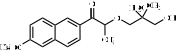
Formel:C20H22O9Reinheit:Min. 95%Molekulargewicht:406.38 g/molNaproxen glucuronide
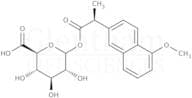
CAS:Naproxen glucuronide: NSAID, propionic class, eases pain, fever, inflammation. Nonselective COX blocker.Formel:C20H22O9Farbe und Form:SolidMolekulargewicht:406.38