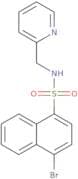
CAS 419538-69-5
:4-Bromo-N-(2-pyridinylmethyl)-1-naphthalinsulfonamid
Beschreibung:
4-Bromo-N-(2-pyridinylmethyl)-1-naphthalinsulfonamid ist eine chemische Verbindung, die durch ihre komplexe Struktur gekennzeichnet ist, die einen Naphthalenring, eine Sulfonamidgruppe und ein Bromatom umfasst. Diese Verbindung weist eine Pyridinstruktur auf, die mit einer Methylgruppe substituiert ist, was zu ihren einzigartigen Eigenschaften beiträgt. Sie ist typischerweise bei Raumtemperatur ein Feststoff und kann je nach spezifischen Bedingungen eine moderate Löslichkeit in organischen Lösungsmitteln aufweisen. Das Vorhandensein der Sulfonamidfunktion deutet auf potenzielle Anwendungen in der medizinischen Chemie hin, insbesondere bei der Entwicklung von Arzneimitteln, da Sulfonamide für ihre antibakteriellen Eigenschaften bekannt sind. Das Bromatom kann auch die Reaktivität der Verbindung erhöhen und ihre biologische Aktivität beeinflussen. Darüber hinaus kann die molekulare Struktur der Verbindung Wechselwirkungen mit biologischen Zielen ermöglichen, was sie für die Arzneimittelentdeckung und -entwicklung von Interesse macht. Sicherheits- und Handhabungsvorkehrungen sollten wie bei jeder chemischen Substanz beachtet werden, aufgrund möglicher Toxizität und Umweltauswirkungen.
Formel:C16H13BrN2O2S
InChl:InChI=1S/C16H13BrN2O2S/c17-15-8-9-16(14-7-2-1-6-13(14)15)22(20,21)19-11-12-5-3-4-10-18-12/h1-10,19H,11H2
InChI Key:InChIKey=GJSDYQXOSHKOGX-UHFFFAOYSA-N
SMILES:S(NCC1=CC=CC=N1)(=O)(=O)C=2C3=C(C(Br)=CC2)C=CC=C3
Synonyme:- Pyrabactin
- 4-Bromo-N-(2-pyridinylmethyl)-1-naphthalenesulfonamide
- 1-Naphthalenesulfonamide, 4-bromo-N-(2-pyridinylmethyl)-
Sortieren nach
Reinheit (%)
0
100
|
0
|
50
|
90
|
95
|
100
2 Produkte.
4-Bromo-N-(pyridin-2-ylmethyl)naphthalene-1-sulfonamide
CAS:4-Bromo-N-(pyridin-2-ylmethyl)naphthalene-1-sulfonamideReinheit:95%Molekulargewicht:377.26g/molPyrabactin
CAS:<p>Pyrabactin is a potent inhibitor of kinases, specifically cyclin-dependent kinase (CDK) and other protein kinases. It is an analog of the Chinese herbal medicine pyrabactin, which has been used for centuries to treat various ailments including cancer. Pyrabactin has been shown to induce apoptosis in cancer cells and inhibit tumor growth in animal models. Additionally, it has anticancer properties due to its ability to inhibit the activity of CDKs, which are essential for cell division and proliferation. Pyrabactin is excreted primarily through urine and has potential as a therapeutic agent for cancer treatment.</p>Formel:C16H13BrN2O2SReinheit:Min. 95%Molekulargewicht:377.3 g/mol