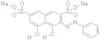
CAS 4197-07-3
:Chromotrop 2R
Beschreibung:
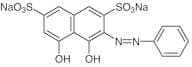
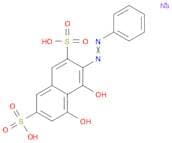
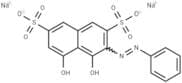
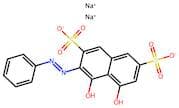
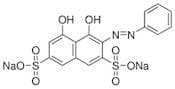
Chromotrop 2R, mit der CAS-Nummer 4197-07-3, ist ein synthetischer Farbstoff, der zur Klasse der Azofarbstoffe gehört und durch seine lebendige rote Farbe gekennzeichnet ist. Er wird hauptsächlich in verschiedenen Anwendungen eingesetzt, einschließlich der Färbung von Textilien, der Papierfärbung und als biologischer Farbstoff in der Mikroskopie. Der Farbstoff zeigt eine gute Löslichkeit in Wasser, was ihn für wässrige Anwendungen geeignet macht. Chromotrop 2R ist bekannt für seine Stabilität gegenüber Licht und Wärme, obwohl er, wie viele Azofarbstoffe, unter extremen Bedingungen eine Zersetzung erfahren kann. Seine chemische Struktur weist Azoverbindungen (-N=N-) auf, die für seine Farbeigenschaften verantwortlich sind. Obwohl er für die beabsichtigten Anwendungen wirksam ist, sind Sicherheitsüberlegungen wichtig, da einige Azofarbstoffe bei der Zersetzung aromatische Amine freisetzen können, die Gesundheitsrisiken darstellen können. Daher erfordert der Umgang mit Chromotrop 2R die Einhaltung von Sicherheitsrichtlinien, um die Exposition zu minimieren. Insgesamt wird Chromotrop 2R für seine Färbeeigenschaften in verschiedenen Industrien geschätzt, aber das Bewusstsein für sein chemisches Verhalten und sein Sicherheitsprofil ist entscheidend.
Formel:C16H12N2O8S2·2Na
InChl:InChI=1S/C16H12N2O8S2.2Na/c19-12-8-11(27(21,22)23)6-9-7-13(28(24,25)26)15(16(20)14(9)12)18-17-10-4-2-1-3-5-10;;/h1-8,19-20H,(H,21,22,23)(H,24,25,26);;
InChI Key:InChIKey=HKJCYVHPXAKYEJ-UHFFFAOYSA-N
SMILES:OC=1C2=C(C=C(S(=O)(=O)O)C1N=NC3=CC=CC=C3)C=C(S(=O)(=O)O)C=C2O.[Na]
Synonyme:- 2,7-Naphthalenedisulfonic acid, 4,5-dihydroxy-3-(2-phenyldiazenyl)-, sodium salt (1:2)
- 2,7-Naphthalenedisulfonic acid, 4,5-dihydroxy-3-(phenylazo)-, disodium salt
- 4,5-Dihydroxy-3-phenylazo-2,7-naphthalenedisulfonic acid,disodium salt
- Acid Red 29
- Acilan Chromotrope RR
- Brasilan Fast Fuchsine G
- Chromotrop 2R
- Chromotrope 2 R
- Chromotrope 2 R (CI 16570)
- Chromotrope Red 2R
- Disodium 4,5-Dihydroxy-3-Phenylazonaphthalene-2,7-Disulphonate
- Disodium 4,5-dihydroxy-3-(phenylazo)naphthalene-2,7-disulfonate
- Fast Fuchsin G
- Fast Fuchsine G
- Hispacid Fuchsin G
- chromotrop 2 R for microscopy and complexometry
- disodium (3Z)-5-hydroxy-4-oxo-3-(phenylhydrazono)-3,4-dihydronaphthalene-2,7-disulfonate
- C.I. Acid Red 29
- Chromotrope 2R
- C.I. Acid Red 29, disodium salt (8CI)
- Chromotrope 2R
- C.I. Acid Red 29, disodium salt
- C.I. Acid Red 29 (7CI)
- chromotrope 2R (C.I. 16570)
- C.I. Acid Red 29
- Acid Red 29~C.I. 16570
- C.I. 16570
- Weitere Synonyme anzeigen
Sortieren nach
Reinheit (%)
0
100
|
0
|
50
|
90
|
95
|
100
8 Produkte.
Chromotrope 2R
CAS:Formel:C16H10N2Na2O8S2Farbe und Form:Amber to Brown powder to crystalMolekulargewicht:468.36Chromotrope 2R
CAS:Employed as an indicator for complexometry. It is also applied as a stain used in modified Gomori Trichrome stain. Used as a stain for cytology. This Thermo Scientific Chemicals brand product was originally part of the Alfa Aesar product portfolio. Some documentation and label information may referFormel:C16H10N2Na2O8S2Farbe und Form:Crystals or powder or crystalline powder, Red to brownMolekulargewicht:468.36Chromotrope 2R
CAS:Chromotrope 2R functions as a chromogenic analytical probe for protein quantification, staining basic proteins red and exhibiting a peak wavelength shift fromFormel:C16H10N2Na2O8S2Farbe und Form:SolidMolekulargewicht:468.37Chromotrope 2R (C.I. 16570)
CAS:Formel:C16H10N2Na2O8S2Farbe und Form:Red to brown powderMolekulargewicht:468.37Chromotrope 2R
CAS:Chromotrope 2R is a chromogenic substrate that is used to assay protothecosis. Phase chromatography of this compound produces two different zones: one that is blue and another that is yellow-green. The blue zone indicates the presence of phosphotungstic acid, which can be used as a diagnostic marker for protothecosis. The yellow-green zone indicates the presence of keratinization, which can be used as a diagnostic marker for protothecosis. Chromotrope 2R has also been shown to inhibit keratinization in tissues, leading to a lack of staining and cellular changes in the surrounding tissue. Prototheca species are filamentous eukaryotic organisms that produce a variety of polyketides and other secondary metabolites. These compounds are toxic to animals when ingested and can lead to hemorrhagic necrosis in both humans and animals. Protothecosis is caused by infection with Prototheca zopfii or Prototheca wFormel:C16H10N2Na2O8S2Farbe und Form:PowderMolekulargewicht:468.37 g/molChromotrope 2R
CAS:Formel:C16H10N2Na2O8S2Farbe und Form:Brownish red, Crystalline powderMolekulargewicht:468.37