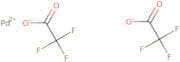
CAS 42196-31-6
:Trifluoracetat von Palladium(II)
Beschreibung:
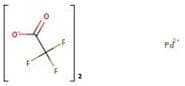
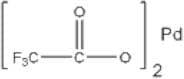
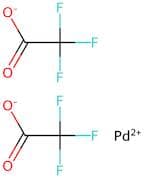
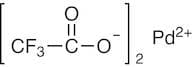
Trifluoracetat von Palladium(II) ist eine Koordinationsverbindung mit der Formel Pd(CF₃COO)₂, bei der Palladium im Oxidationszustand +2 vorliegt. Diese Verbindung erscheint typischerweise als weißes bis hellgelbes Feststoff und ist bekannt für ihre Rolle als Katalysator in verschiedenen organischen Reaktionen, insbesondere in Kreuzkopplungsreaktionen wie den Suzuki- und Heck-Reaktionen. Die Trifluoracetat-Liganden sind starke elektronenanziehende Gruppen, die die Reaktivität des Palladiumzentrums erhöhen. Trifluoracetat von Palladium(II) ist in organischen Lösungsmitteln löslich, was es für die Verwendung in der organischen Synthese geeignet macht. Es ist wichtig, diese Verbindung mit Vorsicht zu behandeln, da Palladiumverbindungen giftig sein können und Umweltgefahren darstellen können. Darüber hinaus ist es empfindlich gegenüber Feuchtigkeit und sollte in einer trockenen Umgebung gelagert werden, um seine Stabilität zu erhalten. Insgesamt ist Trifluoracetat von Palladium(II) ein wertvolles Reagenz im Bereich der organometallischen Chemie und Katalyse.
Formel:C4F6O4Pd
InChl:InChI=1/2C2HF3O2.Pd/c2*3-2(4,5)1(6)7;/h2*(H,6,7);/q;;+2/p-2
SMILES:C(=O)(C(F)(F)F)O.C(=O)(C(F)(F)F)O.[Pd]
Synonyme:- Palladium trifluoroacetate
- Palladium(2+) Bis(Trifluoroacetate)
- Palladium(II) trifluoroacetate
- Palladium(Ⅱ) trifluoroacetate
Sortieren nach
Reinheit (%)
0
100
|
0
|
50
|
90
|
95
|
100
10 Produkte.
Palladium(II) trifluoroacetate, 97%
CAS:Palladium(II) trifluoroacetate is used in the preparation of allyl-palladium complexes. It acts as a catalyst used in the mild decarboxylation of electron-rich aromatic acids and the direct cross-coupling of unactivated arenes. Further, it is involved in the selective allylic oxidation of geranylaceFormel:C4F6O4PdReinheit:97%Farbe und Form:Brown, Powder or crystals or crystalline powderMolekulargewicht:332.45Palladium(II) trifluoroacetate, min. 97%
CAS:Palladium(II) trifluoroacetate, min. 97%
Formel:Pd(OOCCF3)2Reinheit:min. 97%Farbe und Form:brown pwdr.Molekulargewicht:332.44Palladium(II) trifluoroacetate
CAS:Formel:C4F6O4PdReinheit:98%Farbe und Form:SolidMolekulargewicht:332.4508Ref: IN-DA003TJG
25gNachfragen50gNachfragen100gNachfragen100mg27,00€250mg37,00€1g86,00€5g232,00€10g613,00€Palladium(II) trifluoroacetate
CAS:Palladium(II) trifluoroacetateFormel:·Pd·2CF3CO2Reinheit:98%Farbe und Form: light brown-red powder powderMolekulargewicht:332.45g/molPalladium(II) Trifluoroacetate
CAS:Formel:C4F6O4PdReinheit:>98.0%(T)Farbe und Form:Light yellow to Brown powder to crystalMolekulargewicht:332.45Palladium(II) trifluoroacetate
CAS:Formel:C4F6O4PdReinheit:98.0%Farbe und Form:SolidMolekulargewicht:332.45Palladium(II) trifluoroacetate
CAS:Palladium(II) trifluoroacetate is a palladium complex with the chemical formula PdCl(CF3CO2). It is soluble in water and reacts with hydroxide solution to form palladium oxide. Palladium complexes have been used as diagnostic agents for their ability to selectively bind to specific proteins. Palladium-catalyzed asymmetric syntheses of organic compounds, such as natural products and pharmaceuticals, are also possible. Palladium complexes often undergo metathesis reactions, which involve the transfer of one ligand from one metal complex to another. The use of deuterium isotopes can be used to differentiate between the two types of palladium complexes that undergo metathesis reactions.Formel:C4F6O4PdReinheit:Min. 95%Farbe und Form:PowderMolekulargewicht:332.45 g/molPalladium(II) Trifluoroacetate
CAS:Kontrolliertes ProduktFormel:(C2HF3O2)·PdFarbe und Form:NeatMolekulargewicht:334.46