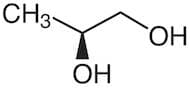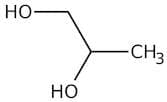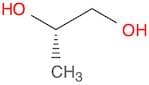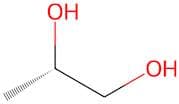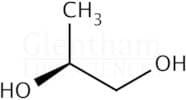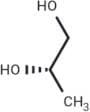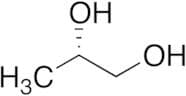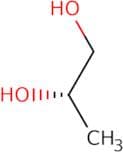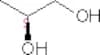
CAS 4254-15-3
:(+)-1,2-Propandiol
Beschreibung:
(+)-1,2-Propandiol, auch bekannt als Propylenglykol, ist eine farb- und geruchloses, hygroskopisches Flüssigkeit mit süßem Geschmack. Es ist ein Diol, was bedeutet, dass es zwei Hydroxylgruppen (-OH) enthält, die zu seiner Löslichkeit in Wasser und verschiedenen organischen Lösungsmitteln beitragen. Diese Verbindung wird häufig in Lebensmitteln, Pharmazeutika und Kosmetika als Feuchthaltemittel, Lösungsmittel und Konservierungsmittel aufgrund ihrer geringen Toxizität und Fähigkeit, Feuchtigkeit zu halten, verwendet. Seine chemische Formel ist C3H8O2, und es hat einen relativ niedrigen Siedepunkt und einen hohen Siedepunkt im Vergleich zu anderen kleinen organischen Molekülen. Die (+) Bezeichnung zeigt an, dass es sich um das Enantiomer mit spezifischer optischer Aktivität handelt, was seine Wechselwirkungen in biologischen Systemen beeinflussen kann. Propylenglykol wird auch in der Herstellung von Frostschutzmitteln und als Träger für Aromen und Düfte verwendet. Sein Sicherheitsprofil wurde gut untersucht und es wird allgemein als sicher (GRAS) von den Aufsichtsbehörden anerkannt, wenn es angemessen verwendet wird.
Formel:C3H8O2
InChl:InChI=1/C6H12O3/c1-5-3-8-4-6(2-7)9-5/h5-7H,2-4H2,1H3/t5?,6-/m0/s1
InChI Key:InChIKey=DNIAPMSPPWPWGF-VKHMYHEASA-N
SMILES:[C@@H](CO)(C)O
Synonyme:- (+)-1,2-Propanediol
- (2S)-1,2-Propanediol
- (2S)-Propane-1,2-diol
- (S)-(+)-1,2-propanediol
- (S)-(+)-Propane-1,2-diol
- (S)-(+)-Propylene glycol
- (S)-2-Hydroxy-1-propanol
- (S)-2-Hydroxypropanol
- 1,2(S)-Propanediol
- 1,2-Propanediol, (2S)-
- 1,2-Propanediol, (S)-
- 3-Deoxy-sn-glycerol
- <span class="text-smallcaps">L</span>-(+)-Propanediol
- <span class="text-smallcaps">L</span>-(+)-Propylene glycol
- <span class="text-smallcaps">L</span>-1,2-Propanediol
- d-Propylene glycol
- L-(+)-Propylene glycol
- PROPYELENE GLYCOL pure
- (S)-(+)-1,2-DIHYDROXYPROPANE
- (S)-(+)-PROPYLENE GLYCEROL
- PROPYLENE GLYCOL extrapure AR
- 1,2-PROPANEDIOL, 1000MG, NEAT
- (S)-(+)-1,2-Propanediol,99%
- (S)-(+)-1,2-Propanediol,97%
- S-1,2-Propancdiol
- ALUMINUM NITRATE NONAHYDRATE 98+% &
- (S)-(+)-PROPANEDIOL
- Weitere Synonyme anzeigen
Sortieren nach
Reinheit (%)
0
100
|
0
|
50
|
90
|
95
|
100
10 Produkte.
(S)-(+)-1,2-Propanediol
CAS:Formel:C3H8O2Reinheit:>98.0%(GC)Farbe und Form:Colorless to Light yellow to Light orange clear liquidMolekulargewicht:76.10(S)-(+)-1,2-Propanediol, 97%
CAS:(S)-(+)-1,2-Propanediol acts as an organic solvent and diluent used in pharmaceutical preparations. It is also used as a chiral synthetic intermediate and substrate for enzyme studies. This Thermo Scientific Chemicals brand product was originally part of the Alfa Aesar product portfolio. Some documeFormel:C3H8O2Reinheit:97%Farbe und Form:Clear colorless, Liquid or viscous liquidMolekulargewicht:76.10Ref: IN-DA0032FV
5gNachfragen10g21,00€1kg120,00€25g25,00€50g25,00€100g28,00€250g55,00€25kgNachfragen500g73,00€50kgNachfragen(S)-(+)-1,2-Propanediol
CAS:(S)-(+)-1,2-PropanediolFormel:C3H8O2Reinheit:98%Farbe und Form: colourless liquidMolekulargewicht:76.09g/molS(+)-Propylene glycol
CAS:Formel:C3H8O2Reinheit:(GC) ≥ 96.0%Farbe und Form:Clear, colourless liquidMolekulargewicht:76.10(S)-(+)-1,2-Propanediol
CAS:(S)-(+)-1,2-Propanediol ((2S)-propane-1,2-diol) is an endogenous compound produced by the engineered bacterium Lactococcus lactis.Formel:C3H8O2Reinheit:99.23%Farbe und Form:Less To Light Yellow Liquid Colorless To Light Yellow LiquidMolekulargewicht:76.09(S)-(+)-Propane-1,2-diol
CAS:Kontrolliertes ProduktApplications (S)-(+)-Propane-1,2-diol is a general reagent used in organic synthesis. (S)-(+)-Propane-1,2-diol is used in the synthesis of anti-tuberculosis agents inspired by BTZ043 for MDR resistant strains.
References Tiwari, R. et al.: ACS Med. Chem. Lett., 5, 587 (2014); Tiwari, R. et al.: J. Am. Chem. Soc., 135, 3539 (2013);Formel:C3H8O2Farbe und Form:ColourlessMolekulargewicht:76.09(S)-(+)-1,2-Propanediol
CAS:(S)-(+)-1,2-Propanediol is a diol that is a chemical compound with the molecular formula HOCHCHOH. It has an asymmetric carbon atom and can exist as two enantiomers (S)-(+)-1,2-propanediol and (R)-(-)-1,2-propanediol. The compound is produced in the laboratory by oxidation of propylene with hydrogen peroxide in the presence of a metal catalyst. It undergoes dehydration reactions to form sugars such as erythritol and xylitol. This process also occurs naturally in some plants and bacteria where glucose is oxidized to form glycerol. The conversion of propane-1,2-diol to glycerol is catalyzed by alcohol dehydrogenase from yeast or fungi such as Candida boidinii or Candida kefyr. It also reacts with other molecules such as proteins via amide formation to form new compounds called aFormel:C3H8O2Reinheit:Min. 98%Farbe und Form:Colorless Slightly Yellow Clear LiquidMolekulargewicht:76.09 g/mol(S)-(+)-1,2-Propanediol
CAS:Formel:C3H8O2Reinheit:97%Farbe und Form:Liquid, ClearMolekulargewicht:76.095