CAS 42553-65-1
:Crocin
Beschreibung:
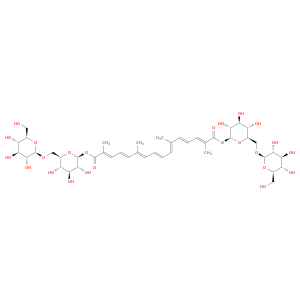
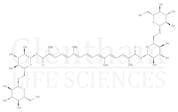
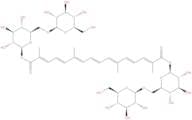
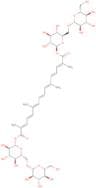
Crocin ist ein Carotinoidpigment, das hauptsächlich aus der Safranpflanze, Crocus sativus, gewonnen wird. Es ist bekannt für seine lebendige gelb-orange Farbe und ist verantwortlich für den charakteristischen Farbton von Safran. Chemisch gesehen ist Crocin ein glykosyliertes Derivat von Crocetin, das aus einem Dicarbonsäure-Rückgrat mit mehreren angehängten Zuckermolekülen besteht, was seine Löslichkeit in Wasser verbessert. Crocin zeigt verschiedene biologische Aktivitäten, einschließlich antioxidativer, entzündungshemmender und potenzieller neuroprotektiver Wirkungen, was es sowohl für die Lebensmittel- als auch für die Pharmaindustrie von Interesse macht. Es wird häufig auf seine potenziellen therapeutischen Anwendungen untersucht, insbesondere im Kontext von neurodegenerativen Erkrankungen und Stimmungsschwankungen. Darüber hinaus wird Crocin für seine Rolle als natürlicher Farbstoff in Lebensmitteln anerkannt, der eine sichere Alternative zu synthetischen Farbstoffen bietet. Seine Stabilität und Bioverfügbarkeit sind wichtige Faktoren für seine Anwendung, und laufende Forschungen untersuchen weiterhin sein volles Spektrum an Gesundheitsvorteilen und Anwendungen.
Formel:C44H64O24
InChl:InChI=1S/C44H64O24/c1-19(11-7-13-21(3)39(59)67-43-37(57)33(53)29(49)25(65-43)17-61-41-35(55)31(51)27(47)23(15-45)63-41)9-5-6-10-20(2)12-8-14-22(4)40(60)68-44-38(58)34(54)30(50)26(66-44)18-62-42-36(56)32(52)28(48)24(16-46)64-42/h5-14,23-38,41-58H,15-18H2,1-4H3/b6-5+,11-7+,12-8+,19-9+,20-10+,21-13+,22-14+/t23-,24-,25-,26-,27-,28-,29-,30-,31+,32+,33+,34+,35-,36-,37-,38-,41-,42-,43+,44+/m1/s1
InChI Key:InChIKey=SEBIKDIMAPSUBY-RTJKDTQDSA-N
SMILES:C(O[C@@H]1O[C@H](CO)[C@@H](O)[C@H](O)[C@H]1O)[C@H]2O[C@@H](OC(/C(=C/C=C/C(=C/C=C/C=C(/C=C/C=C(/C(O[C@@H]3O[C@H](CO[C@@H]4O[C@H](CO)[C@@H](O)[C@H](O)[C@H]4O)[C@@H](O)[C@H](O)[C@H]3O)=O)\C)\C)/C)/C)=O)[C@H](O)[C@@H](O)[C@@H]2O
Synonyme:- 6-O-β-D-glucopyranosyl-1-O-[(2E,4E,6E,8E,10Z,12E,14Z)-16-{[(6-O-β-D-glucopyranosyl-β-D-glucopyranosyl)oxy]methyl}-2,6,11,15-tetramethylheptadeca-2,4,6,8,10,12,14,16-octaenoyl]-β-D-glucopyranose
- 8,8′-Diapo-ψ,ψ-carotenedioic acid, bis(6-O-β-<span class="text-smallcaps">D</smallcap>-glucopyranosyl-β-<smallcap>D</span>-glucopyranosyl) ester
- Crocetin bis(gentiobiosyl) ester
- Crocetin di(β-<span class="text-smallcaps">D</span>-gentiobiosyl) ester
- Crocetin di-β-gentiobiosyl ester
- Crocetin digentiobioside
- Crocin
- Crocin (gardenia fruit
- Crocin 1
- Crocin 4
- Crocin A
- Kiriyasu Oil Yellow GY
- Saffron
- Saffron (Natural)
- Trans-crocin-1
- all-trans-Crocetin di-β-<span class="text-smallcaps">D</span>-gentiobiosyl ester
- bis[(2S,3R,4S,5S,6R)-3,4,5-trihydroxy-6-({[(2R,3R,4S,5S,6R)-3,4,5-trihydroxy-6-(hydroxymethyl)tetrahydro-2H-pyran-2-yl]oxy}methyl)tetrahydro-2H-pyran-2-yl] (2E,4E,6E,8E,10E,12E,14E)-2,6,11,15-tetramethylhexadeca-2,4,6,8,10,12,14-heptaenedioate (non-preferred name)
- trans-Crocetin di(β-<span class="text-smallcaps">D</span>-gentiobiosyl) ester
- α-Crocin
- β-<span class="text-smallcaps">D</smallcap>-Glucopyranose, 6-O-β-<smallcap>D</span>-glucopyranosyl-, 1,1′-[(2E,4E,6E,8E,10E,12E,14E)-2,6,11,15-tetramethyl-2,4,6,8,10,12,14-hexadecaheptaenedioate]
- 8,8′-Diapo-ψ,ψ-carotenedioic acid, bis(6-O-β-D-glucopyranosyl-β-D-glucopyranosyl) ester
- Weitere Synonyme anzeigen
Sortieren nach
Reinheit (%)
0
100
|
0
|
50
|
90
|
95
|
100
13 Produkte.
Crocin (Gardenia Fruits Extract)
CAS:Formel:C44H64O24Reinheit:multi component mixture(HPLC)Farbe und Form:Light yellow to Brown powder to crystalMolekulargewicht:976.97Crocin
CAS:Crocin: a water-soluble carotenoid in saffron, used for flavoring, coloring, and in Chinese medicine; inhibits TNF-alpha-induced apoptosis in cells.Formel:C44H64O24Reinheit:98.13% - 99.27%Farbe und Form:Solid /Di-Gentiobiose Ester/ SolidMolekulargewicht:976.96Crocin I, 98%
CAS:Formel:C44H64O24Reinheit:(HPLC) ≥ 98.0%Farbe und Form:Orange to dark red powderMolekulargewicht:976.97Crocin I
CAS:Crocin is a water-soluble carotenoid pigment of saffron (Crocus sativus L.), it has been used as a spice for flavoring and coloring food preparations. Crocin has anti-inflammatory, anti-oxidative, anti-apoptotic, anti-asthma, anti-cancer, and hypolipidemic effects. Crocin improves toxic effects of diazinon via reducing lipid peroxidation and restoring altered contractile and relaxant responses in rat aorta; it also protects retinal photoreceptors against light-induced cell death. Crocin can also promote ovarian cancer HO-8910 cell apoptosis, most likely by increasing p53 and Fas/APO-1 expression, and then activating the apoptotic pathway regulated by Caspase-3.Formel:C44H64O24Reinheit:95%~99%Molekulargewicht:976.972Crocin
CAS:Natural glycosideFormel:C44H64O24Reinheit:≥ 95.0 % (HPLC)Farbe und Form:PowderMolekulargewicht:976.98Crocin
CAS:Stability Light Sensitive
Applications Crocin, is a natural carotenoid derived the flowers crocus and gardenia. Crocin has been shown to be a potent antioxidant. It has also been shown to have an antiproliferative action against cancer cells in vitro, and also possessing possible antidepressant properties.
References Zheng, Y. Q., et al.: Brain Res., 1138, 86 (2006); Hosseinzadeh, H., et al.: PTR, 24 (5), 726 (2010); Ochiai, T., et al.: Biochim. Biophys. Acta., 1770(4), 578 (2006);Formel:C44H64O24Farbe und Form:Dark Yellow Crystalline PowderMolekulargewicht:976.96Crocin I
CAS:Crocin is a pharmaceutical product which is an antipyretic and analgesic medication, primarily composed of paracetamol (acetaminophen). It is synthesized through chemical processes originally derived from coal tar, although modern production predominantly utilizes petrochemical sources. The mode of action of Crocin involves the inhibition of cyclooxygenase (COX) enzymes, particularly COX-2, in the central nervous system. This action leads to a decrease in the synthesis of prostaglandins, which are responsible for pain and fever.Formel:C44H64O24Reinheit:Min. 98.0 Area-%Farbe und Form:PowderMolekulargewicht:976.96 g/molCrocin - microscopy grade
CAS:Crocin is a carotenoid found in the fruit of Crocus sativus. It has been shown to have potential anticancer activity, as well as antioxidant and anti-inflammatory properties. Crocin has demonstrated significant cytotoxicity against cancer cells in vitro. The mechanism of action is not fully understood, but it may be due to its ability to inhibit oxidative injury and receptor activity. Crocin has also been shown to have an effect on eye disorders such as retinitis pigmentosa and macular degeneration, which may be due to its antioxidant properties. The analytical method for crocin is high performance liquid chromatography (HPLC). HPLC separation is achieved using a reversed-phase column with gradient elution using water, acetonitrile and methanol. Preparative HPLC is used for isolation from natural sources.Formel:C44H64O24Reinheit:Min. 95%Farbe und Form:PowderMolekulargewicht:976.96 g/mol