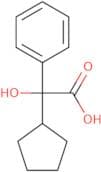
CAS 427-49-6
:α-Cyclopentylmandelsäure
Beschreibung:
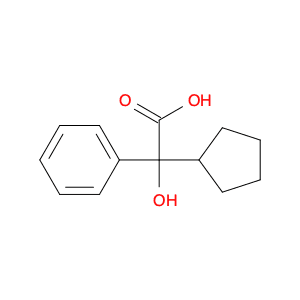
α-Cyclopentylmandelsäure, mit der CAS-Nummer 427-49-6, ist eine organische Verbindung, die durch ihre einzigartige Cyclopentylgruppe, die an die Struktur der Mandelsäure gebunden ist, gekennzeichnet ist. Diese Verbindung weist ein chirales Zentrum auf, was zu ihrer potenziellen optischen Aktivität beiträgt. Sie erscheint typischerweise als weißes bis off-white kristallines Feststoff und ist in polaren Lösungsmitteln wie Wasser und Alkoholen löslich, was auf die Anwesenheit der Carbonsäurefunktion zurückzuführen ist. Die Cyclopentylgruppe kann die Hydrophobizität und die biologische Aktivität der Verbindung beeinflussen, was sie in der medizinischen Chemie und der Arzneimittelentwicklung von Interesse macht. α-Cyclopentylmandelsäure kann verschiedene biologische Eigenschaften aufweisen, einschließlich antimikrobieller oder entzündungshemmender Wirkungen, obwohl die spezifischen Aktivitäten je nach strukturellen Modifikationen und der Anwesenheit von Substituenten variieren können. Ihre Synthese umfasst oft die Reaktion von Cyclopentyl-Derivaten mit Mandelsäure oder deren Vorläufern. Wie viele organische Säuren kann sie an Säure-Base-Reaktionen teilnehmen und Salze mit Basen bilden, was für ihre Anwendungen in der Pharmazie und der organischen Synthese relevant sein kann.
Formel:C13H16O3
InChl:InChI=1S/C13H16O3/c14-12(15)13(16,11-8-4-5-9-11)10-6-2-1-3-7-10/h1-3,6-7,11,16H,4-5,8-9H2,(H,14,15)
InChI Key:InChIKey=WFLUEQCOAQCQLP-UHFFFAOYSA-N
SMILES:C(C(O)=O)(O)(C1=CC=CC=C1)C2CCCC2
Synonyme:- (2R)-cyclopentyl(hydroxy)phenylethanoate
- (2S)-cyclopentyl(hydroxy)phenylethanoate
- (±)-Cyclopentylmandelic acid
- 2-Cyclopentyl-2-hydroxy-2-(phenyl)acetic acid
- 2-Cyclopentyl-2-hydroxy-2-phenylacetic acid
- 2-Cyclopentylmandelic acid
- Benzeneacetic acid, α-cyclopentyl-α-hydroxy-
- Cyclopentyl(Hydroxy)Phenylacetic Acid
- Cyclopentylhydroxyphenylacetic acid
- Mandelic acid, α-cyclopentyl-
- NSC 96637
- alpha-Cyclopentylmandelic acid
- α-Cyclopentyl-α-hydroxybenzeneacetic acid
- α-Cyclopentylmandelic acid
- ALFA-CYCLOPENTYLMANDELIC ACID
- Weitere Synonyme anzeigen
Sortieren nach
Reinheit (%)
0
100
|
0
|
50
|
90
|
95
|
100
11 Produkte.
α-Cyclopentyl-DL-mandelic Acid
CAS:Formel:C13H16O3Reinheit:>98.0%(T)(HPLC)Farbe und Form:White to Light yellow powder to crystalMolekulargewicht:220.27Glycopyrrolate Related Compound C (2-Cyclopentyl-2-hydroxy-2-phenylacetic acid)
CAS:Carboxylic acids w/ alcohol function but w/o other oxygen function and their derivatives, nesoiFormel:C13H16O3Farbe und Form:White Off-White PowderMolekulargewicht:220.109942-Cyclopentyl-2-hydroxy-2-phenylacetic acid
CAS:Formel:C13H16O3Reinheit:96%Farbe und Form:SolidMolekulargewicht:220.2643Glycopyrronium Bromide EP Impurity J (Glycopyrrolate USP Related Compound C)
CAS:Formel:C13H16O3Farbe und Form:Off-White SolidMolekulargewicht:220.272-Cyclopentyl-2-hydroxy-2-phenylacetic acid
CAS:2-Cyclopentyl-2-hydroxy-2-phenylacetic acidReinheit:98%Molekulargewicht:220.27g/mol2-(RS)-Cyclopentyl-2-hydroxy-2-phenylacetic Acid (α-Cyclopentylmandelic Acid)
CAS:Farbe und Form:Neat2-Cyclopentyl-2-hydroxy-2-phenylacetic Acid
CAS:Applications 2-Cyclopentyl-2-hydroxy-2-phenylacetic Acid is an impurity of Glycopyrrolate (G657000), a novel pharmaceutical compound based on PDE IV inhibitors; used in the treatment of respiratory complaints. It is used in the synthesis of muscarinic M3 receptor antagonists.
References Gomez, et al.: Br. J. Anaesth., 74, 549 (1995); Kumar, N. et al.: Bioorg. Med. Chem. Lett., 17, 5256 (2007);Formel:C13H16O3Farbe und Form:Off White To Light BrownMolekulargewicht:220.26Cyclopentylmandelic acid
CAS:Cyclopentylmandelic acid (CPM) is a bifunctional drug that binds to the receptors of the adrenergic system and acts as an agonist. It has been shown to have a matrix effect, which stabilizes and minimizes the effects of other drugs. CPM can also reduce carbonyl groups in the body, which are linked to stress and aging. CPM is a synthetic drug that was first isolated by chromatography. The structural formula for this drug is similar to that of cyclopentanol, with the exception of one methyl group on its side chain. CPM has been shown to have anticholinergic properties, meaning it blocks acetylcholine receptors in nerve cells and leads to dry mouth, blurred vision, constipation, and urinary retention.Formel:C13H16O3Farbe und Form:White PowderMolekulargewicht:220.27 g/mol