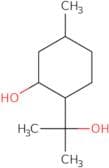
CAS 42822-86-6
:p-Menthan-3,8-diol
Beschreibung:
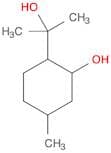
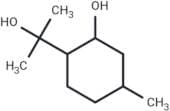
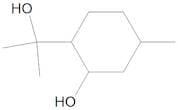
p-Menthan-3,8-diol, auch bekannt als Mentholglykol oder Menthan-3,8-diol, ist eine bicyclische organische Verbindung, die aus Menthol abgeleitet ist. Es weist eine einzigartige Struktur auf, die durch ein Menthan-Gerüst mit Hydroxylgruppen an den Positionen 3 und 8 gekennzeichnet ist, was zu seinen chemischen Eigenschaften beiträgt. Diese Verbindung ist typischerweise eine farblose bis blassgelbe Flüssigkeit mit einem angenehmen minzigen Geruch, was sie für verschiedene Anwendungen, insbesondere in der Duft- und Geschmacksindustrie, attraktiv macht. p-Menthan-3,8-diol zeigt antimikrobielle Eigenschaften, die in Körperpflegeprodukten und als Konservierungsmittel von Vorteil sein können. Es ist auch bekannt für sein kühlendes Gefühl, ähnlich wie Menthol, was es nützlich in topischen Formulierungen zur Linderung von Hautirritationen macht. Die Verbindung ist in Alkohol und Ölen löslich, hat jedoch eine begrenzte Löslichkeit in Wasser. Ihre Stabilität und das niedrige Toxizitätsprofil erhöhen zusätzlich ihre Nützlichkeit in Verbrauchermärkten. Insgesamt wird p-Menthan-3,8-diol für seine sensorischen Eigenschaften und funktionalen Vorteile in verschiedenen Formulierungen geschätzt.
Formel:C10H20O2
InChl:InChI=1/C10H20O2/c1-7-4-5-8(9(11)6-7)10(2,3)12/h7-9,11-12H,4-6H2,1-3H3
InChI Key:InChIKey=LMXFTMYMHGYJEI-UHFFFAOYSA-N
SMILES:C(C)(C)(O)C1C(O)CC(C)CC1
Synonyme:- 1-Hydroxy-2-(1-methyl-1-hydroxyethyl)-5-methylcyclohexane
- 1-Hydroxy-5-methyl-2-(1-methyl-1-hydroxyethyl)cyclohexane
- 2-(1-Hydroxy-1-Methylethyl)-5-Methylcyclohexanol
- 2-(2-Hydroxypropan-2-Yl)-5-Methylcyclohexan-1-Ol
- 2-(2-Hydroxypropan-2-yl)-5-methylcyclohexanol
- 255-953-7
- 3,8-p-Menthanediol
- 42822-86-6
- Citrepel
- Citriodiol
- Citriodiol(p-Menthane-3,8-diol)
- Cooling agent 38D
- Cyclohexanemethanol, 2-hydroxy-α,α,4-trimethyl-
- Cyclohexanol, 2-(2-hydroxy-2-propyl)-5-methyl-
- Geranium cyclohexane
- Geranodyle
- L6Tj Axq1&1 Bq D1
- P-Menthane-3,8-Diol
- p-Menthan-3,8-diol
- 2-Hydroxy-α,α,4-trimethylcyclohexanemethanol
- 2-hydroxy-alpha,alpha,4-trimethylcyclohexanemethanol
- p-Menthane-3,8-diol (Natural)
- 2-Hydroxy-α,α,4-trimethyL
- PMD/p-Menthane-3,8-diol
- 3,8 PMD
- p-Menthane-3,8-diol 98%
- citroethol
- Menediol
- Water soluble montanediol
- PARA-MENTHANE-3,8-DIOL
- p-Menthane-3,8-diol USP/BP/EP
- 2-hydroxy-α
- Geranodyle 5464203
- p-Menthane-3,8-diol (7CI)
- Raw Material 820 Medicinel CAS 42822-86-6
- 1-(2-Hydroxy-4-methylcyclohexyl)-1-methylethanol
- 2-Hydroxy-4,α,α-trimethylcyclohexanemethanol
- P-Menthane-3, 8-Diol / Pmd
- (+)-cis-p-Menthane-3,8-diol@100 μg/mL in Acetonitrile
- Meng diol
- p-Methane-3,8-diol
- 2-(2-hydroxypropan-2-yl)-5-methyl-cyclohexan-1-ol
- Weitere Synonyme anzeigen
Sortieren nach
Reinheit (%)
0
100
|
0
|
50
|
90
|
95
|
100
6 Produkte.
2-(2-Hydroxypropan-2-Yl)-5-Methylcyclohexanol
CAS:2-(2-Hydroxypropan-2-Yl)-5-MethylcyclohexanolReinheit:95%,mixtureMolekulargewicht:172.26g/molp-Menthane-3,8-diol
CAS:p-Menthane-3,8-diol(2-(2-hydroxypropan-2-yl)-5-methylcyclohexan-1-ol) is a cyclohexanol that is used in organic synthesis and biochemical experiments.Formel:C10H20O2Farbe und Form:SolidMolekulargewicht:172.272-Hydroxy-α,α,4-trimethylcyclohexanemethanol
CAS:Kontrolliertes ProduktApplications 2-Hydroxy-α,α,4-trimethylcyclohexanemethanol is used in protection measures in the prevention of tick-born diseases. Acaricide.
References Cisak, E. et al.: Annals Agri. Env. Med., 19, 625 (2012); Gbenou, J. et al.: Mol. Biol. Rep., 40, 1127 (2013);Formel:C10H20O2Farbe und Form:NeatMolekulargewicht:172.26p-Menthane-3,8-diol - 95%
CAS:p-Menthane-3,8-diol is a naturally occurring compound that exerts a repellent effect on insects such as mosquitos and fleas. It is a colourless solid that is extracted from Eucalyptus plants or synthesised commercially. It comes in the form a racemic mixture of cis- and trans- isomers, with the cis isomer being more active than the trans isomer as an insect repellent.Formel:C10H20O2Reinheit:Min. 95%Farbe und Form:Solidified MassMolekulargewicht:172.26 g/mol