CAS 4295-04-9
:4-Chlor-6-methoxychinolin
Beschreibung:
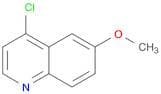
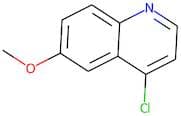
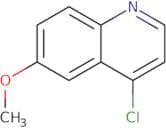
4-Chlor-6-methoxychinolin ist eine organische Verbindung, die durch ihre Chinolinstruktur gekennzeichnet ist, die aus einem fusionierten Benzol- und Pyridinring besteht. Das Vorhandensein eines Chloratoms an der Position 4 und einer Methoxygruppe an der Position 6 trägt zu ihren einzigartigen chemischen Eigenschaften bei. Diese Verbindung erscheint typischerweise als gelbes bis braunes Feststoff und ist in Wasser schwer löslich, aber besser löslich in organischen Lösungsmitteln wie Ethanol und Aceton. Sie zeigt eine moderate Stabilität unter Standardbedingungen, kann jedoch Reaktionen durchlaufen, die für Chinolinderivate typisch sind, wie elektrophile Substitution oder nucleophile Angriffe aufgrund der elektronenanziehenden Natur des Chloratoms. 4-Chlor-6-methoxychinolin hat in der medizinischen Chemie Interesse geweckt wegen seiner potenziellen biologischen Aktivitäten, einschließlich antimikrobieller und antitumoraler Eigenschaften. Ihre Synthese umfasst oft die Chlorierung von Methoxychinolinderivaten, und sie kann mit Techniken wie NMR-Spektroskopie und Massenspektrometrie analysiert werden, um ihre Struktur und Reinheit zu bestätigen. Wie bei vielen chemischen Substanzen sind eine ordnungsgemäße Handhabung und Sicherheitsvorkehrungen aufgrund der potenziellen Toxizität und der Umweltauswirkungen unerlässlich.
Formel:C10H8ClNO
InChl:InChI=1/C10H8ClNO/c1-13-7-2-3-10-8(6-7)9(11)4-5-12-10/h2-6H,1H3
SMILES:COc1ccc2c(c1)c(ccn2)Cl
Sortieren nach
Reinheit (%)
0
100
|
0
|
50
|
90
|
95
|
100
4 Produkte.
4-Chloro-6-methoxyquinoline
CAS:Formel:C10H8ClNOReinheit:95%Farbe und Form:SolidMolekulargewicht:193.62964-Chloro-6-methoxyquinoline
CAS:4-Chloro-6-methoxyquinolineFormel:C10H8ClNOReinheit:98%Farbe und Form: brown crystalline solidMolekulargewicht:193.63g/mol4-Chloro-6-methoxyquinoline
CAS:Formel:C10H8ClNOReinheit:95%Farbe und Form:SolidMolekulargewicht:193.634-Chloro-6-methoxyquinoline
CAS:4-Chloro-6-methoxyquinoline is an inhibitor of bacterial DNA gyrase. It has antibacterial activity against Gram-positive and Gram-negative bacteria, including Staphylococcus aureus, Enterococcus faecalis, and Pseudomonas aeruginosa. 4-Chloro-6-methoxyquinoline is a synthetic compound that was reinvestigated for its antibacterial activity. It has been shown to be effective in the treatment of Staphylococcal infections. The mechanism of action may involve inhibition of topoisomerase II or interference with the synthesis of DNA by binding to the enzyme bacterial DNA gyrase. Quinidine and cinchonidine are quinine derivatives that have been found to inhibit bacterial DNA gyrase. These compounds are found in the bark of Cinchona species, which includes Cinchona ledgeriana, Cinchona officinalis, and Cinchona succirubFormel:C10H8ClNOReinheit:Min. 95%Molekulargewicht:193.63 g/mol