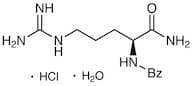
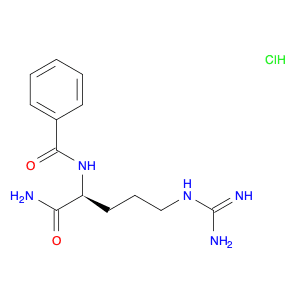
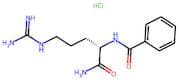
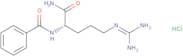
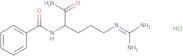
![Benzamide, N-[1-(aminocarbonyl)-4-[(aminoiminomethyl)amino]butyl]-, monohydrochloride, (S)-](/_next/image/?url=https%3A%2Fstatic.cymitquimica.com%2Fcas-image%2Fthumb-webp%2F41128-benzamide-n-1-aminocarbonyl-4-aminoiminomethyl-amino-butyl-monohydrochloride-s.webp&w=3840&q=75)
CAS 4299-03-0
:Benzamid, N-[1-(aminocarbonyl)-4-[(aminoiminomethyl)amino]butyl]-, monohydrochlorid, (S)-
Beschreibung:
Benzamid, N-[1-(aminocarbonyl)-4-[(aminoiminomethyl)amino]butyl]-, monohydrochlorid, (S)- ist eine chemische Verbindung, die durch ihre komplexe Struktur gekennzeichnet ist, die eine Benzamid-Gruppe und mehrere funktionelle Gruppen wie Amino- und Carbonylgruppen umfasst. Diese Verbindung ist typischerweise ein weißer bis off-white fester Stoff und ist aufgrund der Anwesenheit polarer funktioneller Gruppen in Wasser löslich. Die Anwesenheit des Hydrochlorids weist darauf hin, dass es sich um eine Salzform handelt, die oft ihre Stabilität und Löslichkeit in wässrigen Lösungen verbessert. Die (S)-Bezeichnung bezieht sich auf ihre spezifische Stereochemie, was darauf hinweist, dass es sich um eines der Enantiomere der Verbindung handelt. Benzamid-Derivate werden häufig wegen ihrer biologischen Aktivität, einschließlich potenzieller pharmazeutischer Anwendungen, untersucht, da sie in der Lage sind, mit verschiedenen biologischen Zielen zu interagieren. Die molekulare Struktur der Verbindung deutet darauf hin, dass sie Eigenschaften im Zusammenhang mit der Enzymhemmung oder der Rezeptormodulation aufweisen könnte, was sie in der medizinischen Chemie und der Arzneimittelentwicklung von Interesse macht.
Formel:C13H19N5O2·ClH
InChl:InChI=1S/C13H19N5O2.ClH/c14-11(19)10(7-4-8-17-13(15)16)18-12(20)9-5-2-1-3-6-9;/h1-3,5-6,10H,4,7-8H2,(H2,14,19)(H,18,20)(H4,15,16,17);1H/t10-;/m0./s1
InChI Key:InChIKey=PYZACNCNNFUUDO-PPHPATTJSA-N
SMILES:C(N[C@@H](CCCNC(=N)N)C(N)=O)(=O)C1=CC=CC=C1.Cl
Synonyme:- Benzamide, N-(1-carbamoyl-4-guanidinobutyl)-, monohydrochloride, <span class="text-smallcaps">L</span>-
- Benzamide, N-[1-(aminocarbonyl)-4-[(aminoiminomethyl)amino]butyl]-, monohydrochloride, (S)-
- Benzoyl-<span class="text-smallcaps">L</span>-arginine amide monohydrochloride
- Benzoyl-Arg-NH2.HCl
- Bz-Arg-NH2 . HCl
- N-carbamoyl-4-{4-[(diaminomethylidene)amino]butyl}benzamide hydrochloride (1:1)
- N-{1-amino-5-[(diaminomethylidene)amino]-1-oxopentan-2-yl}benzamide
- N-α-Benzoyl-<span class="text-smallcaps">L</span>-argininamide hydrochloride
- N2-(phenylcarbonyl)-L-argininamide hydrochloride
- NSC 343719
- α-N-Benzoyl-<span class="text-smallcaps">L</span>-argininamide hydrochloride
- Benzoyl-L-arginine amide monohydrochloride
- α-N-Benzoyl-L-argininamide hydrochloride
- Weitere Synonyme anzeigen
Sortieren nach
Reinheit (%)
0
100
|
0
|
50
|
90
|
95
|
100
6 Produkte gefunden.
Nα-Benzoyl-L-argininamide Hydrochloride Monohydrate
CAS:Formel:C13H19N5O2·HCl·H2OReinheit:>98.0%(T)(HPLC)Farbe und Form:White to Light yellow powder to crystalMolekulargewicht:331.81(S)-N-(1-Amino-5-guanidino-1-oxopentan-2-yl)benzamide hydrochloride
CAS:Formel:C13H20ClN5O2Reinheit:98.0%Farbe und Form:SolidMolekulargewicht:313.7832(S)-N-(1-Amino-5-guanidino-1-oxopentan-2-yl)benzamide hydrochloride
CAS:(S)-N-(1-Amino-5-guanidino-1-oxopentan-2-yl)benzamide hydrochlorideReinheit:95%Molekulargewicht:313.79g/mol(S)-N-(1-Amino-5-guanidino-1-oxopentan-2-yl)benzamide hydrochloride
CAS:Formel:C13H20ClN5O2Reinheit:95.0%Farbe und Form:SolidMolekulargewicht:313.79N-alpha-Benzoyl-L-arginine amide hydrochloride
CAS:N-alpha-Benzoyl-L-arginine amide hydrochloride (BA) is a synthetic, noncompetitive inhibitor of phosphodiesterase. It has been shown to inhibit protease activity in vitro and rhizosphere enzyme activities in vivo. BA also inhibits the formation of hippuric acid from benzoic acid, which is a reaction catalyzed by the enzyme phosphatase. The kinetics of this inhibition have been studied using a number of different substrates and enzymes. BA binds to the catalytic site on the enzyme, sterically hindering binding of the substrate and preventing hydrolysis.Formel:C13H19N5O2·HClReinheit:Min. 95%Farbe und Form:PowderMolekulargewicht:313.78 g/molBz-Arg-NH2 • HCl • H20
CAS:Bz-Arg-NH2 is a proteolytic variant of the enzyme arginase. It is inactivated by ammonium sulfate and competitively by constant. The active site of Bz-Arg-NH2 contains an aldehyde group, which is responsible for its proteolytic activity. Peptides & Biochemicals offers this product as a solute to be used in affinity chromatography and filtration experiments. This product has been shown to be most active at pH 6.0 with an optimum temperature of 37°C. The chloromethyl ketone can be used as a marker for this product during fractionation due to its fluorescing properties.
Formel:C13H19N5O2•HCI•H2OReinheit:Min. 95%Molekulargewicht:331.8 g/mol