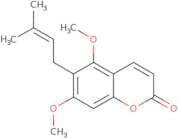
CAS 4335-12-0
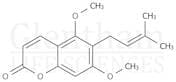
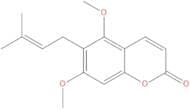
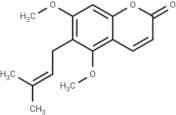
:5,7-dimethoxy-6-(3-methylbut-2-en-1-yl)-2H-chromen-2-on
- 2H-1-Benzopyran-2-one, 5,7-dimethoxy-6-(3-methyl-2-buten-1-yl)-
- 2H-1-Benzopyran-2-one, 5,7-dimethoxy-6-(3-methyl-2-butenyl)-
- 5,7-Dimethoxy-6-(3-methyl-2-buten-1-yl)-2H-1-benzopyran-2-one
- Coumarin, 5,7-dimethoxy-6-(3-methyl-2-butenyl)-
- Toddaculin
- Toddaculine
- 6-(3-Methyl-2-butenyl)-5,7-dimethoxy-2H-1-benzopyran-2-one
- 5,7-dimethoxy-6-(3'-methyl-2'-butenyl)coumarin
- 5,7-Dimethoxy-6-(3-methyl-2-butenyl)-2H-1-benzopyran-2-one
6-(3-Methyl-2-butenyl)-5,7-dimethoxy-2H-1-benzopyran-2-one
CAS:Formel:C16H18O4Reinheit:95%Molekulargewicht:274.3117Toddaculin
CAS:Toddaculine may be beneficial for the prevention and treatment of osteoporosis, it can not only inhibit the differentiation of osteoclasts via activation of theFormel:C16H18O4Reinheit:99.91%Farbe und Form:SolidMolekulargewicht:274.31Toddaculin
CAS:Toddaculin is a synthetic peptide derivative, which is produced through a complex process of peptide synthesis techniques involving solid-phase peptide synthesis (SPPS) and advanced chromatography for purification. Its mode of action involves specific binding to neuronal receptors, modulating synaptic activity and influencing neurotransmitter release. This allows for precise studies of synaptic mechanisms and neural network behavior.
In the realm of neuroscience research, Toddaculin is applied to investigate synaptic plasticity, neuroregulation, and signal transduction pathways. Its precise interactions with neuronal receptors make it a valuable tool for studying the pharmacodynamics of neurological processes and potential therapeutic targets for neurodegenerative diseases. Toddaculin's unique properties facilitate the exploration of cellular responses and neural pathway modulations under controlled experimental conditions.Formel:C16H18O4Reinheit:Min. 95%Molekulargewicht:274.31 g/mol