CAS 435-97-2
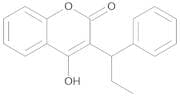
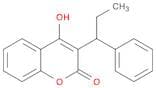
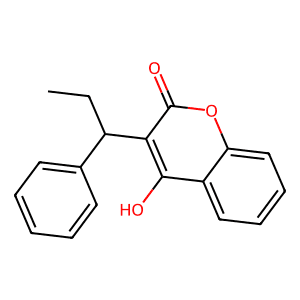
:2H-1-Benzopyran-2-on, 4-hydroxy-3-(1-phenylpropyl)-
Beschreibung:
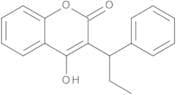
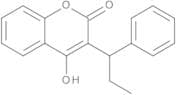
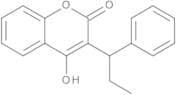
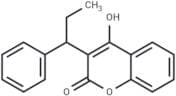
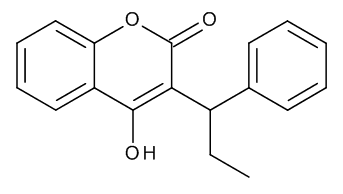
2H-1-Benzopyran-2-on, 4-hydroxy-3-(1-phenylpropyl)-, allgemein bekannt als eine Flavonoidverbindung, weist mehrere bemerkenswerte Eigenschaften auf. Diese Substanz verfügt über ein Chromon-Gerüst, das eine fusionierte Benzol- und Pyrone-Ringstruktur ist, die zu ihren aromatischen Eigenschaften beiträgt. Die Anwesenheit einer Hydroxylgruppe an der Position 4 erhöht ihr Potenzial für Wasserstoffbrückenbindungen und steigert ihre Löslichkeit in polaren Lösungsmitteln. Die phenylpropylische Substitution an der Position 3 trägt zu ihrem hydrophoben Charakter bei, was ihre biologische Aktivität und Interaktion mit Zellmembranen beeinflusst. Diese Verbindung ist bekannt für ihre antioxidativen Eigenschaften, die auf das konjugierte Doppelbindungssystem innerhalb der Chromonstruktur zurückzuführen sind. Darüber hinaus kann sie verschiedene pharmakologische Wirkungen zeigen, einschließlich entzündungshemmender und krebsbekämpfender Aktivitäten, was sie in der medizinischen Chemie von Interesse macht. Ihre CAS-Nummer, 435-97-2, ermöglicht eine einfache Identifizierung in chemischen Datenbanken und erleichtert die Forschung und Anwendung in verschiedenen Bereichen, einschließlich Pharmazie und Chemie natürlicher Produkte.
Formel:C18H16O3
InChl:InChI=1/C18H16O3/c1-2-13(12-8-4-3-5-9-12)16-17(19)14-10-6-7-11-15(14)21-18(16)20/h3-11,13,19H,2H2,1H3
InChI Key:InChIKey=DQDAYGNAKTZFIW-UHFFFAOYSA-N
SMILES:C(CC)(C1=C(O)C=2C(OC1=O)=CC=CC2)C3=CC=CC=C3
Synonyme:- (.+-.)-Phenprocoumon
- 3-(1-Phenylpropyl)-4-hydroxycoumarin
- 3-(α-Ethylbenzyl)-4-hydroxycoumarin
- 3-(α-Phenylpropyl)-4-hydroxycoumarin
- 4-Hydroxy-2-oxo-3-(1-phenylpropyl)-2H-chromene
- 4-Hydroxy-3-(1-phenylpropyl)-2H-1-benzopyran-2-one
- <span class="text-smallcaps">DL</span>-3-(α-Ethylbenzyl)-4-hydroxycoumarin
- Bs 7565
- Coumarin, 3-(α-ethylbenzyl)-4-hydroxy-
- DL-3-(α-Ethylbenzyl)-4-hydroxycoumarin
- Falithrom
- Fencumar
- Fenprocoumona
- Liquamar
- Marcoumar
- Marcumar
- Phenprocoumarol
- Phenprocoumarole
- Phenprocoumone
- Phenprocumon
- Ro 1-4849
- 2-hydroxy-3-(1-phenylpropyl)-4H-chromen-4-one
- 4-hydroxy-3-(1-phenylpropyl)coumarin
- 4-hydroxy-3-(1-phenylpropyl)-2H-chromen-2-one
- 2H-1-Benzopyran-2-one, 4-hydroxy-3-(1-phenylpropyl)-
- PHENYLPROPYL-4-HYDROXYCOUMARIN
- Coumarin, 3-(alpha-ethylbenzyl)-4-hydroxy-
- 4-Hydroxy-3-(1-phenylpropyl)-2H-chromen-2-on
- 3-(1'-Phenyl-propyl)-4-oxycoumarin
- 3-(alpha-Ethylbenzyl)-4-hydroxycoumarin
- MARCUMA
- 2-hydroxy-3-[(1S)-1-phenylpropyl]-4H-chroMen-4-one
- Phenprocoumon (Marcumar)
- Phenprocumone
- Weitere Synonyme anzeigen
Sortieren nach
Reinheit (%)
0
100
|
0
|
50
|
90
|
95
|
100
13 Produkte.
Phenprocoumon 100 µg/mL in Acetonitrile
CAS:Formel:C18H16O3Farbe und Form:Single SolutionMolekulargewicht:280.32Phenprocoumon
CAS:Phenprocoumon is an antagonist of vitamin K(IC50:1 μM).Formel:C18H16O3Reinheit:95.79% - 97.98%Farbe und Form:Fine White Crystalline Powder SolidMolekulargewicht:280.32Phenprocoumon
CAS:Kontrolliertes ProduktApplications Phenprocoumon is known for being an oral anti-coagulant.
Not a dangerous good if item is equal to or less than 1g/ml and there is less than 100g/ml in the package
References Kohl, C. et al.: Drug. Metab. Disp., 28, 161 (2000);Formel:C18H16O3Farbe und Form:White To Off-WhiteMolekulargewicht:280.32Phenprocoumon
CAS:Kontrolliertes ProduktApplications Phenprocoumon is known for being an oral anti-coagulant.
References Kohl, C. et al.: Drug. Metab. Disp., 28, 161 (2000);Formel:C18H16O3Farbe und Form:White To Off-WhiteMolekulargewicht:280.32Phenprocoumon
CAS:Phenprocoumon is a drug that belongs to the class of coumarin derivatives. It is used as an oral anticoagulant for the prevention and treatment of thrombosis or embolism in patients with atrial fibrillation, chronic deep venous thrombosis, or pulmonary embolism. Phenprocoumon prevents clot formation by inhibiting vitamin K-dependent factors necessary for blood coagulation. This drug may also be used to control bleeding in persons with hemophilia A or B. Phenprocoumon has been shown to decrease the rate of myocardial infarction (heart attack) and mortality rates in patients who have had a previous myocardial infarction. The mechanism by which phenprocoumon works is not well understood but it is known that this drug may interact with other drugs such as nonsteroidal anti-inflammatory drugs (NSAIDs).Formel:C18H16O3Reinheit:Min. 95%Molekulargewicht:280.32 g/mol