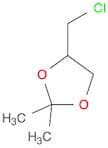
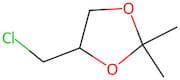
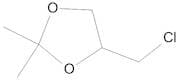
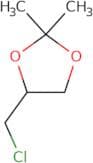
CAS 4362-40-7
:4-(Chlormethyl)-2,2-dimethyl-1,3-dioxolan
Beschreibung:
4-(Chlormethyl)-2,2-dimethyl-1,3-dioxolan ist eine organische Verbindung, die durch ihre Dioxolan-Ringstruktur gekennzeichnet ist, die zwei Sauerstoffatome in einem fünfgliedrigen Ring aufweist. Das Vorhandensein einer Chloromethylgruppe (-CH2Cl) an der Position 4 und zweier Methylgruppen an der Position 2 trägt zu ihren einzigartigen chemischen Eigenschaften bei. Diese Verbindung ist typischerweise eine farblose bis blassgelbe Flüssigkeit mit einem charakteristischen Geruch. Sie ist in organischen Lösungsmitteln löslich und kann aufgrund der Chloromethylgruppe eine moderate Reaktivität aufweisen, die an nucleophilen Substitutionsreaktionen teilnehmen kann. Die Dioxolan-Einheit ist bekannt für ihre Stabilität und wird häufig als Schutzgruppe in der organischen Synthese verwendet. Darüber hinaus kann die Verbindung Anwendungen in der Synthese von Arzneimitteln oder Agrochemikalien haben, da ihre funktionellen Gruppen weitere chemische Umwandlungen erleichtern können. Sicherheitsvorkehrungen sollten beim Umgang mit dieser Substanz getroffen werden, da sie gesundheitliche Risiken darstellen kann, wenn sie eingeatmet oder eingenommen wird.
Formel:C6H11ClO2
InChl:InChI=1/C6H11ClO2/c1-6(2)8-4-5(3-7)9-6/h5H,3-4H2,1-2H3/t5-/m1/s1
InChI Key:InChIKey=BNPOTXLWPZOESZ-UHFFFAOYSA-N
SMILES:C(Cl)C1OC(C)(C)OC1
Synonyme:- (4R)-4-(chloromethyl)-2,2-dimethyl-1,3-dioxolane
- (4S)-4-(chloromethyl)-2,2-dimethyl-1,3-dioxolane
- 1,3-Dioxolane, 4-(chloromethyl)-2,2-dimethyl-
- 1-Chloro-2,3-O-isopropylidenepropane
- Ai3-17556
- Brn 0104463
- 5-19-01-00085 (Beilstein Handbook Reference)
- 4-(Chloromethyl)-2,2-dimethyl-1,3-dioxolane
- (±)-4-(Chloromethyl)-2,2-dimethyl-1,3-dioxolane
- 4-Chloromethyl-2,2-dimethyl-1,3-dioxolane
- 4-(chloromethyl)-2,2-dimethyl-3-dioxolane
- 4-(CHLOROMETHYL)-2,2-DIMETHYL-1,3- DIOXOLANE 99%
- 4-(Chloromethyl)-2,2-dimethyl-1,3-dioxolane,99%
- 4-chloromethyl-2,2-dimethyl-3-dioxolane
- Weitere Synonyme anzeigen
Sortieren nach
Reinheit (%)
0
100
|
0
|
50
|
90
|
95
|
100
5 Produkte.
1,3-Dioxolane,4-(chloromethyl)-2,2-dimethyl-
CAS:Formel:C6H11ClO2Reinheit:98%Farbe und Form:LiquidMolekulargewicht:150.60334-(Chloromethyl)-2,2-dimethyl-1,3-dioxolane
CAS:4-(Chloromethyl)-2,2-dimethyl-1,3-dioxolaneReinheit:96%Molekulargewicht:150.60g/mol4-Chloromethyl-2,2-dimethyl-1,3-dioxolane
CAS:Kontrolliertes ProduktApplications 4-Chloromethyl-2,2-dimethyl-1,3-dioxolane is used in biosynthetic preparations.
Not a dangerous good if item is equal to or less than 1g/ml and there is less than 100g/ml in the package
References Spelberg, J.H., Tetrahedron, Asy., 10, 2863 (1999);Formel:C6H11ClO2Farbe und Form:NeatMolekulargewicht:150.60334-(Chloromethyl)-2,2-dimethyl-1,3-dioxolane
CAS:Formel:C6H11ClO2Reinheit:98%Farbe und Form:LiquidMolekulargewicht:150.64-Chloromethyl-2,2-dimethyl-1,3-dioxolane
CAS:4-Chloromethyl-2,2-dimethyl-1,3-dioxolane is a chemical compound that is used as a marker to identify the presence of fatty acids in plant tissues. It can be synthesized by reacting chloroacetaldehyde with methanol and sodium hydroxide. This compound has a cyclic structure and is chiral. It is also used for mass spectrometric analysis of fatty acid composition in plants. The synthesis of 4-chloromethyl-2,2-dimethyl-1,3-dioxolane involves four steps: (i) chlorination of acetaldehyde with sodium hypochlorite; (ii) hydrolysis of the resulting chloroacetaldehyde with methanol and sodium hydroxide; (iii) oxidation of the resulting chloroformate with hydrogen peroxide; and (iv) hydrolysis of the resulting 4-chloromethyloxymethanol with water.Formel:C6H11ClO2Reinheit:Min. 95%Molekulargewicht:150.6 g/mol