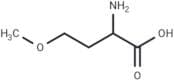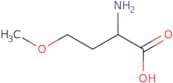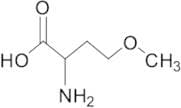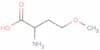
CAS 4385-91-5
:O-Methylhomoserin
Beschreibung:
O-Methylhomoserin, mit der CAS-Nummer 4385-91-5, ist ein Aminosäurederivat, das durch das Vorhandensein einer Methylgruppe gekennzeichnet ist, die an die Hydroxylgruppe von Homoserin gebunden ist. Diese Verbindung wird typischerweise als nicht-proteinogene Aminosäure klassifiziert, was bedeutet, dass sie während der Translation nicht in Proteine eingebaut wird. O-Methylhomoserin ist aufgrund seiner polaren funktionellen Gruppen, die Wasserstoffbrückenbindungen erleichtern, in Wasser löslich. Es spielt eine Rolle in verschiedenen biochemischen Stoffwechselwegen, insbesondere bei der Synthese bestimmter Aminosäuren und Metaboliten. Die Verbindung wird häufig im Kontext der Pflanzenbiochemie und des mikrobiellen Stoffwechsels untersucht, wo sie als Zwischenprodukt in der Biosynthese essentieller Verbindungen dienen kann. Ihre Strukturformel umfasst eine Hydroxylgruppe, eine Carbonsäuregruppe und eine Aminogruppe, die zu ihrer Reaktivität und ihren Wechselwirkungen in biologischen Systemen beiträgt. Wie viele Aminosäurederivate kann O-Methylhomoserin an verschiedenen chemischen Reaktionen teilnehmen, einschließlich Esterifizierung und Amidierung, was es in der synthetischen organischen Chemie und Biochemie von Interesse macht.
Formel:C5H11NO3
InChl:InChI=1S/C5H11NO3/c1-9-3-2-4(6)5(7)8/h4H,2-3,6H2,1H3,(H,7,8)
InChI Key:InChIKey=KFHRMMHGGBCRIV-UHFFFAOYSA-N
SMILES:C(C(O)=O)(CCOC)N
Synonyme:- 2-Amino-4-methoxybutanoic acid
- A 7572
- Butanoate, 2-Amino-4-Methoxy-, Calcium Salt (1:1)
- Butyric acid, 2-amino-4-methoxy-
- Butyric acid, 2-amino-4-methoxy- (8CI)
- Butyric acid, 2-amino-4-methoxy-, DL-
- DL-2-Amino-4-methoxybutanoic acid
- Homoserine, O-methyl-
- Methoxine
- Methoxinine
- Nsc 9325
- O-Methylhomoserine
- Weitere Synonyme anzeigen
Sortieren nach
Reinheit (%)
0
100
|
0
|
50
|
90
|
95
|
100
3 Produkte.
Methoxine
CAS:Methoxine is an oxygen analog of methionine.Formel:C5H11NO3Farbe und Form:SolidMolekulargewicht:133.14572-Amino-4-methoxybutanoic acid
CAS:2-Amino-4-methoxybutanoic acid (2AMBA) is a diagnostic agent that belongs to the class of hydroxyl group containing antimicrobial agents. It has been shown to have conformational properties, which are the spatial arrangement of atoms in a molecule. 2AMBA is a small molecule with neutral pH and has been used as a substrate for peptide synthesis by the yeast Pichia pastoris. 2AMBA has also been shown to have antimicrobial activity against infectious diseases such as Escherichia coli and Pseudomonas aeruginosa, among others. This compound is synthesized by reacting malonic acid with an amine or amide. The reaction forms a cyclic peptide that contains a disulfide bond and fatty acid, which are important for its structure and function.
Formel:C5H11NO3Reinheit:Min. 95%Farbe und Form:PowderMolekulargewicht:133.15 g/mol2-amino-4-methoxybutanoic Acid
CAS:Kontrolliertes ProduktFormel:C5H11NO3Farbe und Form:NeatMolekulargewicht:133.146