CymitQuimica logo

CAS 4403-20-7

:

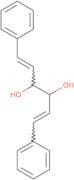
1,6-Diphenyl-1,5-hexadien-3,4-diol

Beschreibung:
1,6-Diphenyl-1,5-hexadien-3,4-diol, mit der CAS-Nummer 4403-20-7, ist eine organische Verbindung, die durch ihre Struktur gekennzeichnet ist, die ein Hexadien-Rückgrat mit zwei Phenylgruppen an den Positionen 1 und 6 und Hydroxylgruppen an den Positionen 3 und 4 aufweist. Diese Verbindung ist typischerweise bei Raumtemperatur ein Feststoff und zeigt Eigenschaften, die sowohl mit aromatischen als auch mit aliphatischen Verbindungen assoziiert sind, aufgrund ihres konjugierten Dienesystems und der Anwesenheit von Hydroxylgruppen. Die Hydroxylgruppen tragen zu ihrem Potenzial für Wasserstoffbrückenbindungen bei, was ihre Löslichkeit in polaren Lösungsmitteln beeinflusst. Darüber hinaus kann die Verbindung aufgrund ihres konjugierten Systems interessante optische Eigenschaften aufweisen, was sie in Studien der Photochemie und Materialwissenschaft relevant macht. Ihre Reaktivität kann durch die Anwesenheit der Hydroxylgruppen beeinflusst werden, die an verschiedenen chemischen Reaktionen teilnehmen können, einschließlich Oxidation und Veresterung. Insgesamt ist 1,6-Diphenyl-1,5-hexadien-3,4-diol von Interesse in der organischen Synthese und kann Anwendungen in der Pharmazie oder als Vorstufe bei der Entwicklung komplexerer organischer Materialien haben.
Formel:C18H18O2
InChl:InChI=1S/C18H18O2/c19-17(13-11-15-7-3-1-4-8-15)18(20)14-12-16-9-5-2-6-10-16/h1-14,17-20H
InChI Key:InChIKey=AVIIWHKOUNFPIY-UHFFFAOYSA-N
SMILES:C(=CC(C(C=CC1=CC=CC=C1)O)O)C2=CC=CC=C2
Synonyme:
  • NSC 222804
  • Hydrocinnamoin
  • 1,6-Diphenyl-1,5-hexadiene-3,4-diol
  • 1,5-Hexadiene-3,4-diol, 1,6-diphenyl-
Sortieren nach

Reinheit (%)
0
100
|
0
|
50
|
90
|
95
|
100
1 Produkte.
  • Hydrocinnamoin

    CAS:
    <p>Hydrocinnamaldehyde is a reactive aldehyde that is used for the synthesis of other compounds. It can be obtained by catalyzing the oxidative cleavage of cinnamyl alcohol. Hydrocinnamaldehyde is also found in marine environments, where it reacts with oxygen to form an unstable compound called hydrocinnamic acid. Hydrocinnamic acid then undergoes an oxidation-reduction process that converts it to hydrocinnamaldehyde. Hydrocinnamaldehyde is one of two carbene precursors used in the Grubbs reaction, which allows for the selective formation of C-C bonds from alkenes and alkynes. The other carbene precursor, methyllithium, is commercially unavailable and has been replaced by hydrocinnamaldehyde as a more economical alternative in this reaction.<br>Hydrocinnamaldehyde can also be used to synthesize palytoxin, which is a toxic compound found in shellfish such as oysters and clams</p>
    Formel:C18H18O2
    Reinheit:Min. 95%
    Farbe und Form:Powder
    Molekulargewicht:266.33 g/mol

    Ref: 3D-FH70547

    2g
    135,00€
    5g
    149,00€
    10g
    203,00€
    25g
    552,00€
    50g
    845,00€