CAS 4423-94-3
:2-Ethylcyclohexanon
Beschreibung:
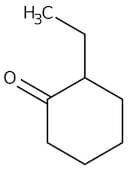
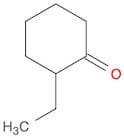
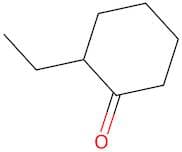
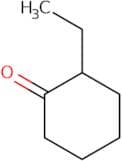
2-Ethylcyclohexanon ist eine cyclische Keton, die durch einen Cyclohexanring mit einer Ethylgruppe und einer Carbonylgruppe (C=O) gekennzeichnet ist. Diese Verbindung erscheint typischerweise als farblose bis blassgelbe Flüssigkeit mit einem charakteristischen Geruch. Sie hat einen moderaten Siedepunkt und ist relativ gut in organischen Lösungsmitteln löslich, während sie in Wasser aufgrund ihrer hydrophoben Natur weniger löslich ist. Die Anwesenheit der Carbonylgruppe macht sie zu einer reaktiven Verbindung, die an verschiedenen chemischen Reaktionen, wie nucleophilen Additionen, teilnehmen kann. 2-Ethylcyclohexanon wird häufig als Zwischenprodukt in der organischen Synthese und in der Herstellung von Duftstoffen, Lösungsmitteln und anderen chemischen Produkten verwendet. Ihre physikalischen und chemischen Eigenschaften, einschließlich Dichte und Viskosität, können je nach Temperatur und Reinheit variieren. Sicherheitsvorkehrungen sollten beim Umgang mit dieser Substanz beachtet werden, da sie Gesundheitsrisiken darstellen kann, wenn sie eingeatmet oder eingenommen wird, und geeignete persönliche Schutzausrüstung verwendet werden sollte.
Formel:C8H14O
InChl:InChI=1/C8H14O/c1-2-7-5-3-4-6-8(7)9/h7H,2-6H2,1H3/t7-/m0/s1
SMILES:CC[C@H]1CCCCC1=O
Synonyme:- (2R)-2-ethylcyclohexanone
- (2S)-2-ethylcyclohexanone
Sortieren nach
Reinheit (%)
0
100
|
0
|
50
|
90
|
95
|
100
5 Produkte.
2-Ethylcyclohexanone, 99%
CAS:2-Ethylcyclohexanone is used as a pharmaceutical intermediate. 2-Methyl and 2-ethyl derivatives of cyclohexanone were allowed to react with deuterium in tBuOD using platinum group metals as catalysts to study the substituent effects in heterogeneous catalysis. This Thermo Scientific Chemicals brandFormel:C8H14OReinheit:99%Farbe und Form:Clear colorless to pale yellow, LiquidMolekulargewicht:126.202-Ethylcyclohexanone
CAS:2-Ethylcyclohexanone is a colorless liquid that has a pungent, sweet odor. It is an alkyl substituent with a conformational isomerization reaction. This process can be catalyzed by sulfide and ethyl bromoacetate. 2-Ethylcyclohexanone also has the ability to form carbonyl groups, which are susceptible to electrophilic substitution reactions with hydroxyl groups. The carbonyl group of 2-ethylcyclohexanone can undergo conformational changes because of its electron donating properties. The carbonyl group in this compound can also react with other nucleophiles that include amines, thiols, and alcohols. 2-Ethylcyclohexanone has been detected in rat brain tissue by nmr spectra and diffraction experiments.Formel:C8H14OReinheit:Min. 95%Molekulargewicht:126.2 g/mol